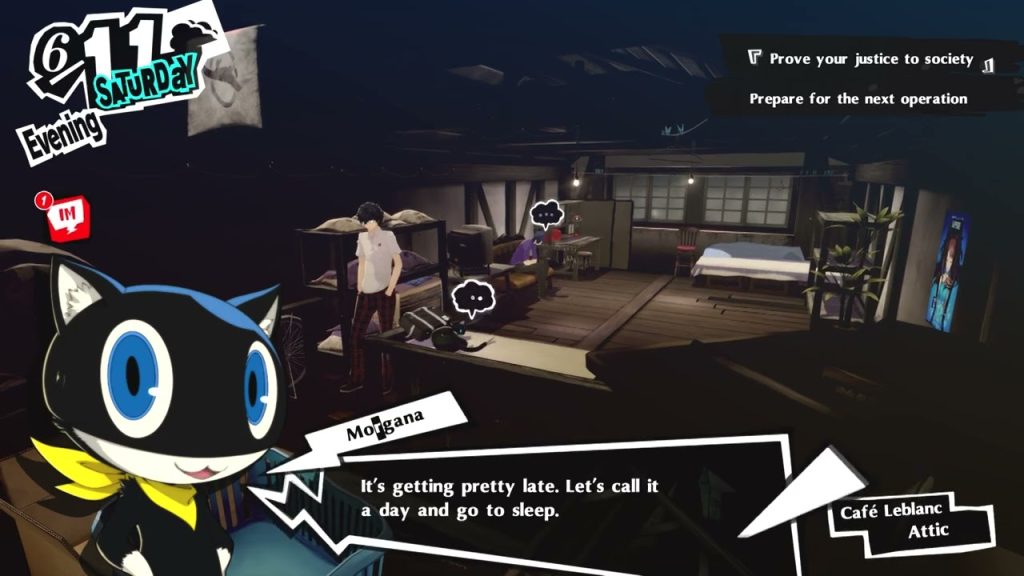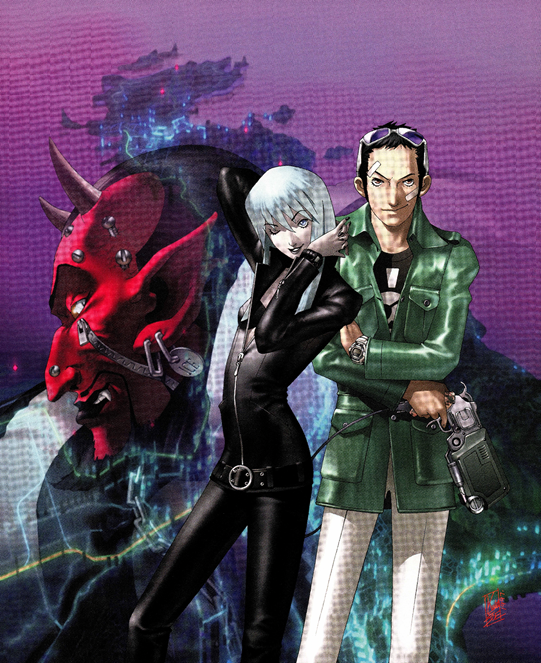
Soul Hackers is an odd game. Originally released for the Sega Saturn in 1997 for Japan only. In the early 2010s — around when I was active in the MegaTen community — it had garnered a reputation as something of a hidden gem. Unlike the mainline games’ bombastic storylines about cosmic conflict and worldending events, the Devil Summoner line of games were more grounded and less shallow. Soul Hackers even had a charming 90s Hackers aesthetic alongside a well-rounded cast of characters, long before that got common for the series.
For a time it was the quintessential “good taste” pick. The kind of title you brought up in conversation to signal that you were indeed a pretty cool guy. When Atlus finally brought Soul Hackers to the west in a snazzy 3DS rerelease in 2013, it seemed like us non-Japanese speakers were finally invited to the cool kids table. See, there was just one issue.
The game was not that good.
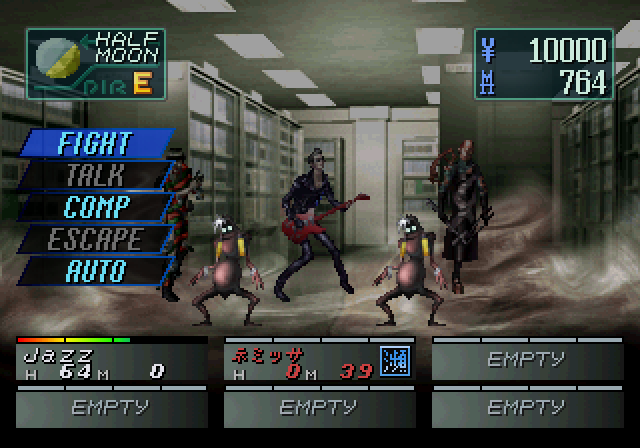
Alright, do not crucify me just yet. Yes, the game is cool and interesting and definitely worth checking out. But it is also an old school dungeon crawler with wonky mechanics and a limited narrative. Mind you, this was at the height of the Persona 4 craze. Press turn and its variants were king and we were just coming off high of a great run of Atlus portable titles such as the Devil Survivor games.
Hallmark mechanics such as demon fusion and significant elemental weaknesses were still very rudimentary. And while the story feels pretty thin by modern standards (even for 2013) it was still a narrative game at its core. Strange Journey had released a couple of years earlier and had also had the same oldschool dungeon crawler gameplay. But unlike Soul Hackers, Strange Journey had a lot of meat to its dungeons. Hidden areas, optional quests and thrilling exploration. Soul Hackers was a game that used the (at the time well-worn) dungeon crawler format as a medium for a Hollywood-esque plot. An odd combination of elements that could probably only happen in 1997.
I will go out on a limb and say that the vibe is the most interesting thing about Soul Hackers and you do not really need to actually play the game to appreciate that. So when the 3DS version finally hit the west, I remember everyone on the boards being excited, only for the conversation to quickly die off when people actually got their hands on the game itself. As it often happens with Japan Only titles, the hype probably outgrew the game itself.
Hack You!
So I have been playing Soul Hackers recently. It is a neat game, one of the few MegaTen games with a western release that I never really got around to beating. It has been on my backlog since, well, 2013 when I bought it on release. I got a sudden urge to play some oldschool MegaTen, so on a whim I decided to pick it up again.
I began looking up emulators almost out of habit, before it hit me. “Wait a minute” I thought. “I own this game. Why am I fiddling around with emulator settings”. So I dusted off my old 3DS (and panicked a bit about finding the charger) and got Soul Hackers loaded up on the SD card. That should have been the end of it. I could finally play the game. But there is an issue.
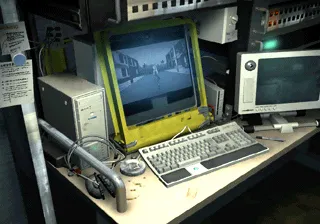
See, I do not play games like I did back in 2011. I comment on them — sometimes I write about them. I take screenshots, I record footage and make small video clips. It is not even that hard. Most modern consoles have built-in capture modes and setting up OBS on a PC is trivial. But the 3DS has none of these features.
What if I stumble on a funny piece of dialog and want to share it? Do you expect me to reiterate it like some medieval peasant who has seen a big shadow in the woods? What is the point of playing this decades old JRPG, if I can’t share my experience?
You do not need to have to have studied Social Science to be familiar with the French philosopher, Michel Foucault ,and his liken of post-modern society to the Panopticon. A (mostly theoretical) prison, designed to allow a single guard to observe any prisoner at any time. The point of the panoptic prison is that the possibility of surveillance would always be present for the inmates. Thus they would always act under the presumption that they were under observation, even if it was physically impossible for the warden to surveil every inmate at the same time.
It is an apt metaphor for society in the 21st century. Not because of surveillance per say (although mass-surveillance has arguably become shockingly normalized), but because the barrier between our public and private spheres of life have been completely eroded. It is probably unnecessary to point out how the rise of modern communication technology has facilitated instant access to the civil sphere and how that has warped our mindset. You can yell at strangers about tax policies while physically being at your niece’s birthday party. And conversely, we willingly invite the public into our private life when we post and share both mundane and intimate moments from our lives.
Chat, are we alone right now?
What shocked me was realizing that this had even infected how I personally approach playing games. I play with a commentators mindset. What do I think about this? Do I have some unique observation or perspective? If you like to talk and discuss video games, the primary exponent of that are streamers and big internet personalities. But they engage with media in a different way from me. Or do they? I have realized that I play stuff as if I have a big following.
The people gotta know what I think of Soul Hackers. The bells are ringing out in London. Hear ye, hear ye! VOKAL does not like managing MAG! It is embarrassing.
One of my favourite sociological concepts is the disembedding of social relations, as described by the English sociologist, Anthony Giddens. As per Giddens’ theory of structuration, social relations (e.g. teacher-student) affect how we move about the world. A teacher is in a position of authority over a student and has the right to determine who speaks at any given moment. But that status is constantly produced and reproduced by continuous actions. The teacher stands in front of the class and the student sits in a row of desks and chairs. That is how we determine who is who.

What Giddens remarked was that these social relations were embedded in a specific time and space. The teacher is a teacher, because of the classroom. In an almost ritualistic fashion, the student comes to the classroom at certain times in order to reaffirm the teacher’s role over them. Even if the teacher-student relation still influences them outside of school, it would slowly weaken and shrink away without the concrete space and time of classes.
However, Giddens observed that social relations in the late-modern society, were increasingly disembedded from specific locales or occasions. Disembedding is my favourite concept, because I am not sure if I can adequately explain it today. I am old enough to remember a time where friendships could consist of “let us meet in the field behind school at 7 and kick a ball around for a bit every Wednesday”. Or acquaintances you only knew because they frequented the same LARP joint as you.
Today it is hard to imagine having a friend where you do not know their contact information, home address or at least their last name. On the internet you can have ephemeral pals where you do not even know what they look like, let alone their legal name. I can tune into my favourite actor’s show regardless of where I am or when it was broadcast. While the old world was a rigid structure of places, times and names, the current one is a big soup with nothing to hold on to.
Let’s start a podcast
What I am trying to convey is that I do not know where to go in order to talk about Soul Hackers. There is no local game club I can saunter down to, with a friendly crowd of regulars who I can relay my experiences to. We can talk about digital spaces that have similar properties as physical ones. Traditional internet forums certainly had a sense of place. Most of the current internet just does have that. Bluesky, Youtube, Discord. It is all soup. Still, the only avenue left for me is to ape the formats and expressions I am presented with.
One thing is how these structures shape our actions, but I am actually more interested in how it morphs our way of thinking. A old interviewer trick, is listening to how people talk about others. If you are trying to gleam some insights about how someone feels about say, dress codes at a workplace, you can listen to how they frame other people’s judgements. If they say something like “If I showed up to work dressed like that, my colleagues would think lesser of me” it is often a sign that they would judge others on that account. This is what Georg Herbert Mead referred to as “the generalized other”. We talk about some “other” person, but in reality it is a reflection of ourself.
Mead would probably be amused to learn that in today’s parlance, we have taken this a step further. For maybe the first time in human history, people now naturally talk from a fourth person perspective. Streamer vernacular has entered into the public lexicon to an extent where people will reflexively refer to “chat” in an audienceless setting. Even if there is an ironic twang to it, we talk as if we always expect someone to be listening in. As Mead might put it, we have developed a generalized audience. Chat, are we cooked?
You can turn off the stream, but can you also turn off the audience in your head? Can you play Soul Hackers on your own?