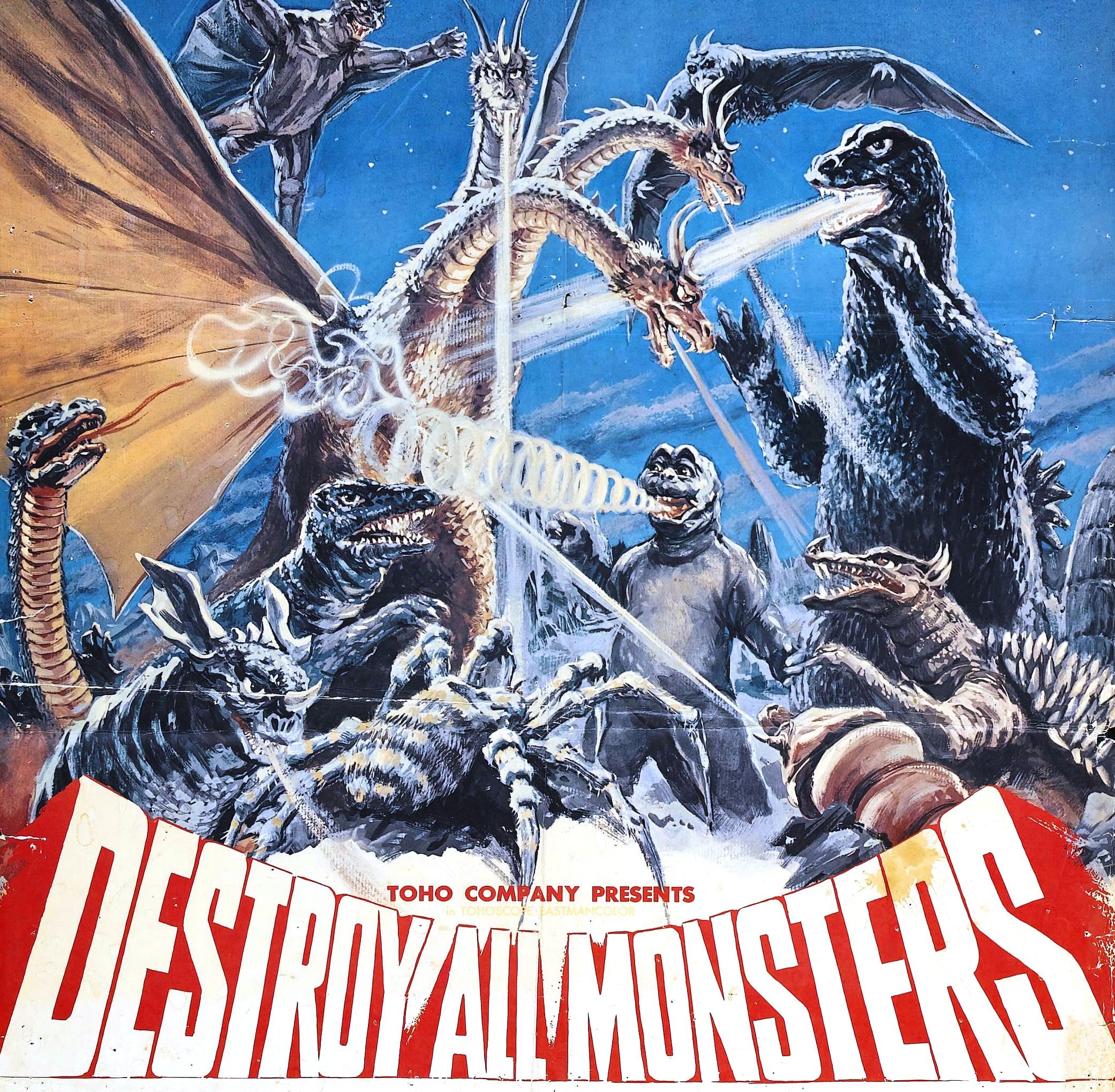
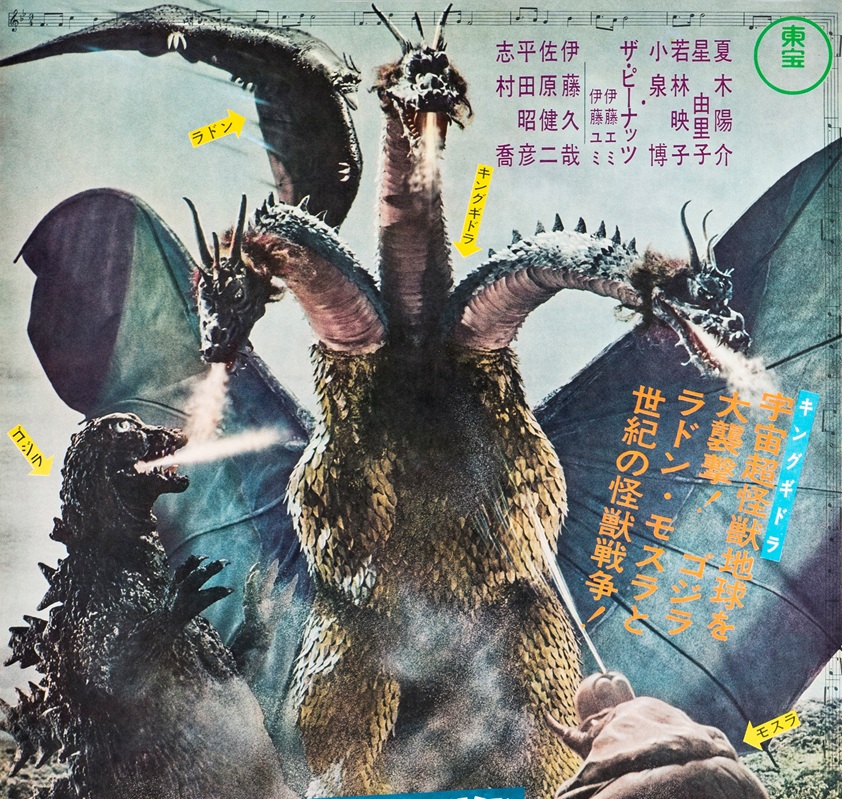
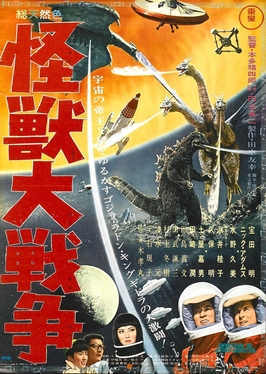
The most succinct way I can describe this movie is »Justice League, but for Godzilla«.
Every time I sit down to write one of these reviews, I resist the urge to open by describing the movie as »a weird one«. Weird is a lazy description. It comes from something being hard to get a grip on. The interesting thing is where that uncertainty comes from.
Destroy All Monsters (1968) is weird — not because the movie itself is overly hard to follow or because its content is that extraordinary. No it is weird, because how the hell did we end up here?
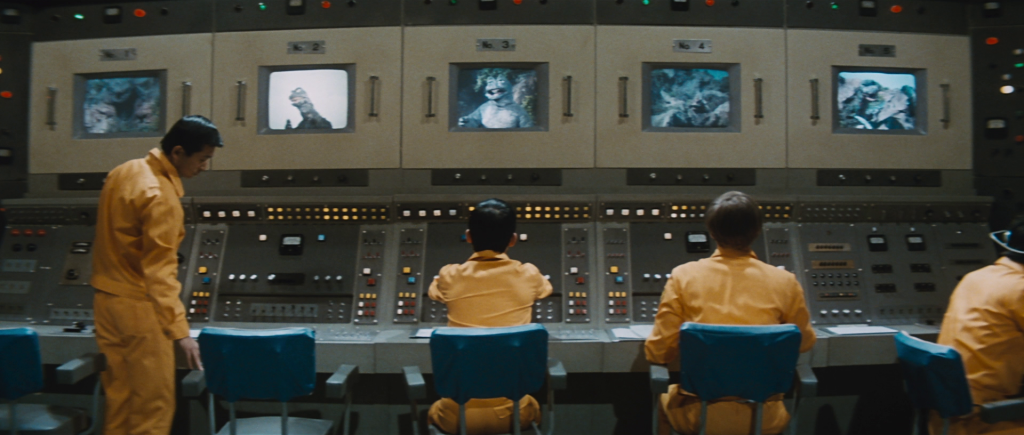
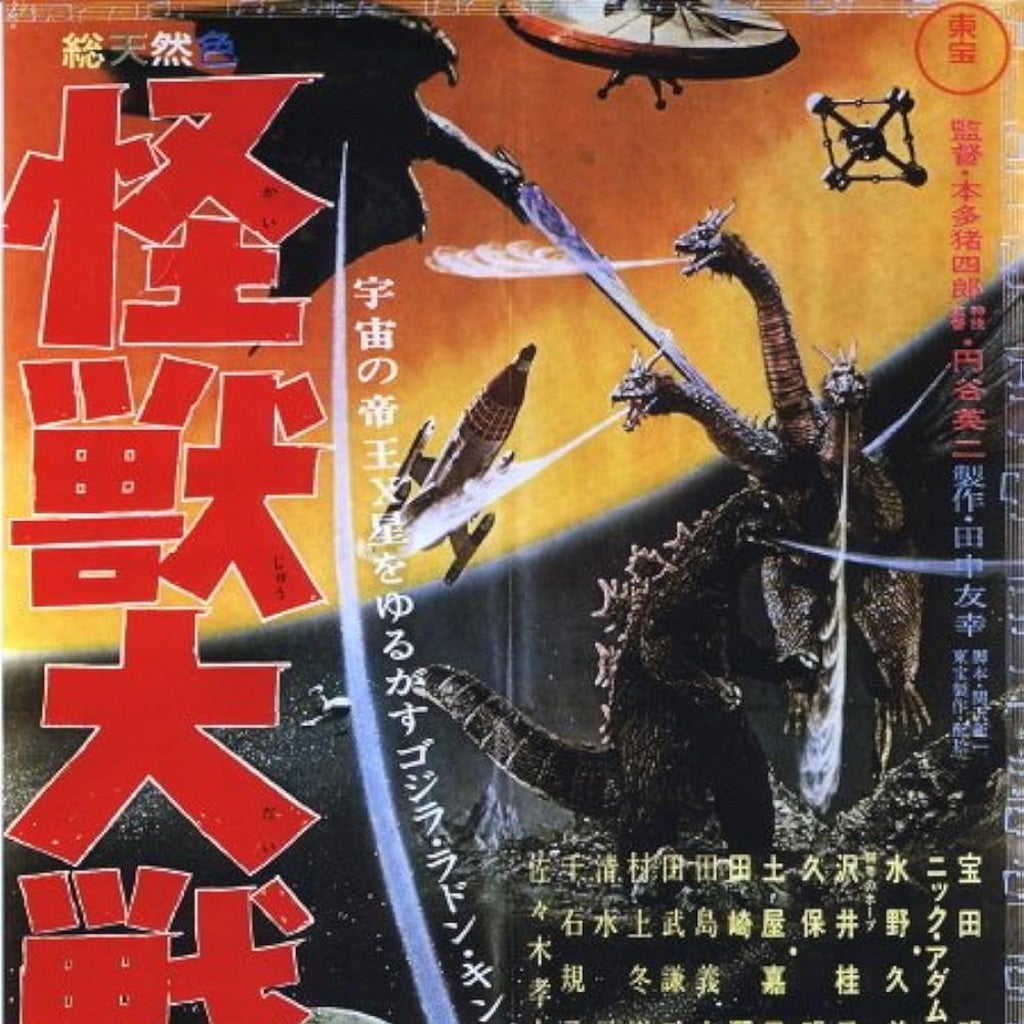
First of all, the plot is explicitly set in the future. We are now all-in on the spacefaring themes that were established in Ghidorah, the Three-headed Dragon and Invasion of the Astro-Monster. The United Nations Science Committee has established an advanced space program, with a permanent moon base to boot. It almost gives a whiff of Star Trek for a hot minute with all the globalist tech-utopianism.
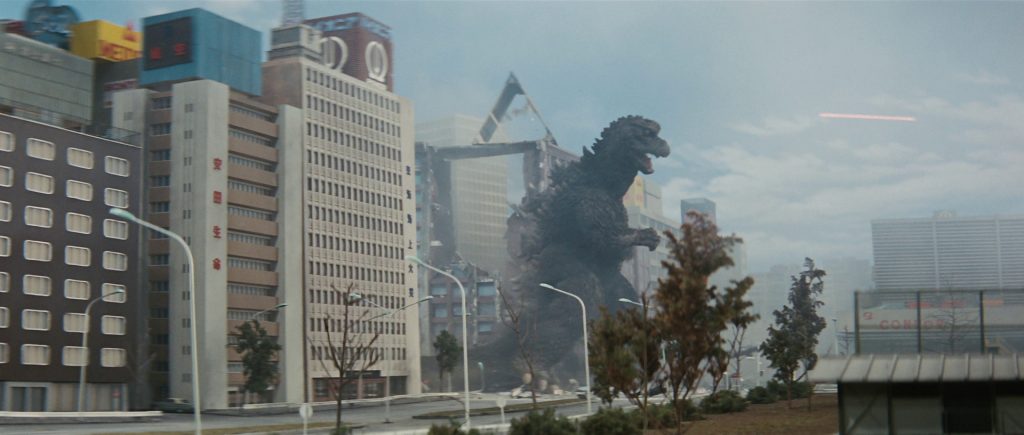
Now, hold my beer, because it does not stop there, because what about all the rampaging monsters from the prior film? That does not sound very utopian. Well, in this future scenario, the UNSC has managed to capture and confine every kaiju to a remote location: Monster Island. A specialized system makes sure that every monster is kept safely on the island. Godzilla even get to spend time with its son (*grumble* *grumble*).
And if that feat of kaiju preservation was not impressive enough, the UNSC has built their primary earth base smack dab in the middle of Monster Island. The premise of this entire operation boggles the mind. And maybe I should not be that surprised. I do know how we got here after all. This tracks with the trajectory of earlier films. We are not in the realm of speculative fiction or ponderings about society through the lens of a kaiju-shaped metaphor. I will reiterate that this is pure sci-fi.
I probably do not need to be explicit about it, but I find this entire scenario to be decidedly dull. Domesticating kaiju is an oxymoronic premise that can only work if you go the route of Jurassic Park. But this movie is not about man’s hubris, how the advancement of tech exasperates our urge to take command of our surroundings. It is about foreign entities spoiling our perfect society.
The plot itself is not exactly gripping. We are back to a hostile alien species that plots to take control over Earth’s monsters and seize the planet itself in the process. There is some back and forth, information is gleamed, plots are unveiled etc. To me it just comes off as a rehash of Astro-Monster, but without the charm of the buddy setup. In the end, the only way to conclude on the plot is for the aliens to call in King Ghidorah again. Godzilla and pals have to reunite and beat up the dragon. Roll credits.
So as I put it initially, this movie gives me flashbacks to watching the Justice League animated series as a kid. And it is not a vibe I particular enjoy for Godzilla.
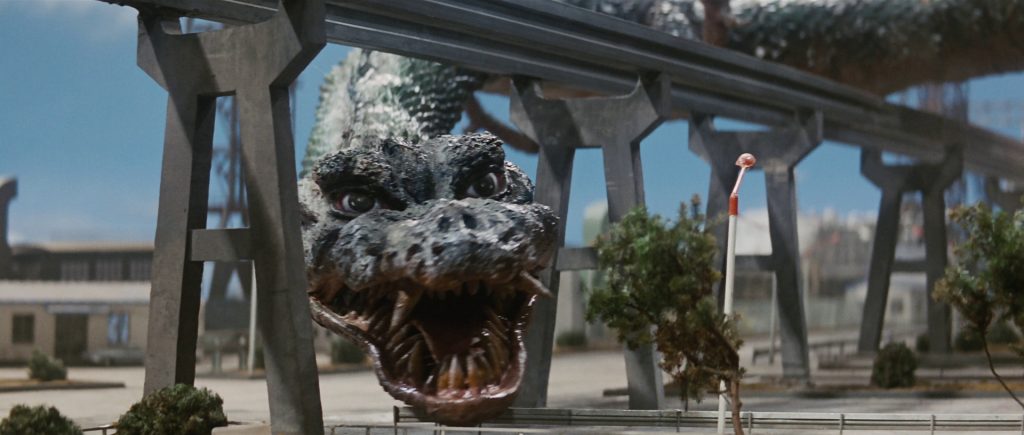
I remember Destroy All Monsters as being a bit of a slog, but is not quite that bad. Most of the individual elements are fine. They just do not coalesce into something that excites me. The most interesting part is mostly the novelty of having so many different monsters running rampant across the globe. Every time we see this movie we always cheer when Manda — a pitiful-looking snake creature — demonstrates its might by destroying a raised highway. It is such a spectacular show of something tame — given too much gravitas.
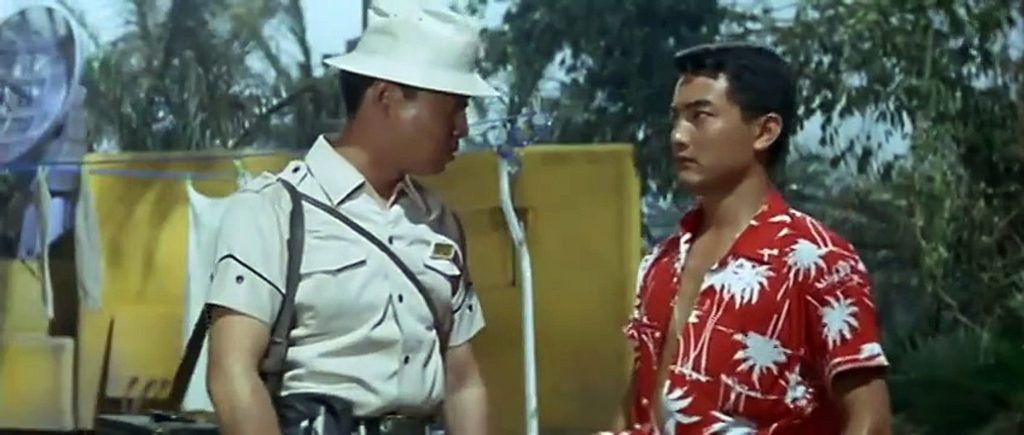
Another fun quirk is the hero of the story being portrayed by the same actor that played the plucky journalist in Son of Godzilla. His role here is much more stern, but I always expect him to suddenly pivot into something more jovial. Recycling actors is very prominent in this era of Godzilla movies — a property of the time that I always enjoy. It adds a theatric flair that I enjoy. It is mostly in this movie that it disturbs my focus.
If there is one interesting thing about Destroy All Monsters, it is that it is the deathblow to the notion of escalation. Throwing in bigger stakes, more monsters and more locations does not keep the movie from feeling stale. Godzilla needs something else to invigorate it.
What are we doing, man? This is a candidate for the height of Showa era schlock. Just throwing stuff at the wall and seeing what sticks. It is exactly as shallow and insipid as you might expect.
»What if Godzilla got a son?« That’s the pitch, the premise — the pathetic reason why we are here. I do not like this movie. It is a slog to watch and there is nothing to really engage with — beyond the spectacle of seeing an infantilized, dopey version of Godzilla.
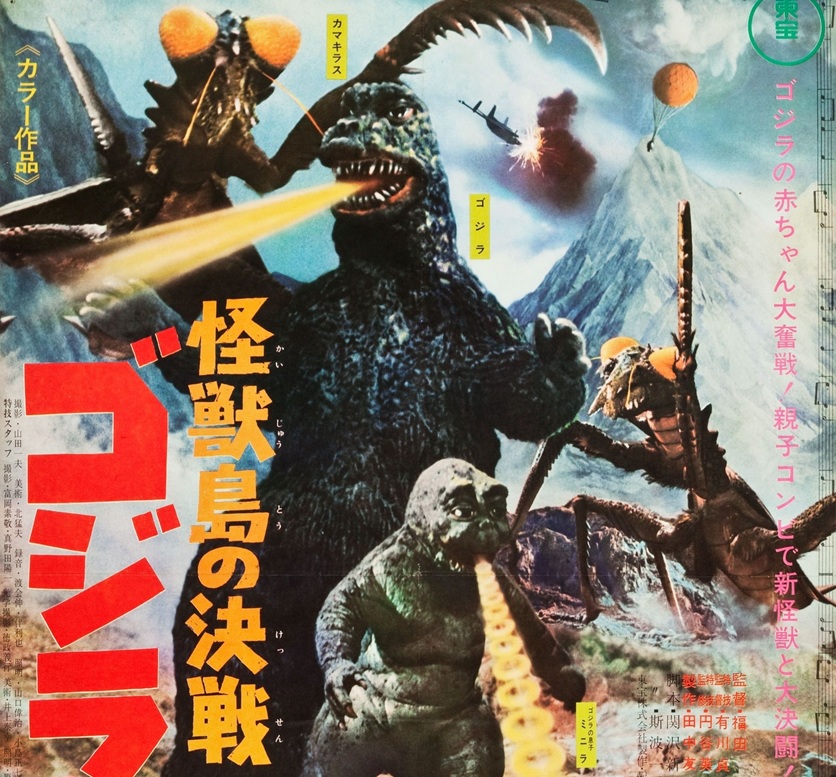
The premise of the movie is yet another island affair and it feels particularly cheap-looking this time. The plot revolves around a scientific expedition that is attempting to build a machine that can manipulate weather. The group — headed by the stern Professor Kusumi — are using the pacific island as a hidden test ground for the new tech. This is complicated by the tenacious journalist Maki Goro, who has (somehow) gotten wind of the project, and has travelled to the island to see what all the secrecy is about.
The reason behind the confidentiality is due to the ways in which weather manipulation could be misused. The tech even uses radioactivity — inadvertently causing some of the local wildlife to mutate and grow to gigantic sizes. As conditions on the island slowly spiral out of control, the Professor resorts to outright manipulation of his disgruntled crew to get them to stay on the island and continue working on the project.
If this sounds even slightly interesting, then I have done too good a job outlining the plot, because in reality, it is a snooze-fest. I like that there is an attempt to tie the plot into the hybris of technology that birthed the series. But it really does not go anywhere. The machinations of the Professor, Maki’s investigation and the implications of the technology — none of it is followed up on. The plot has to shift to the real star of the movie: the titular son of Godzilla.
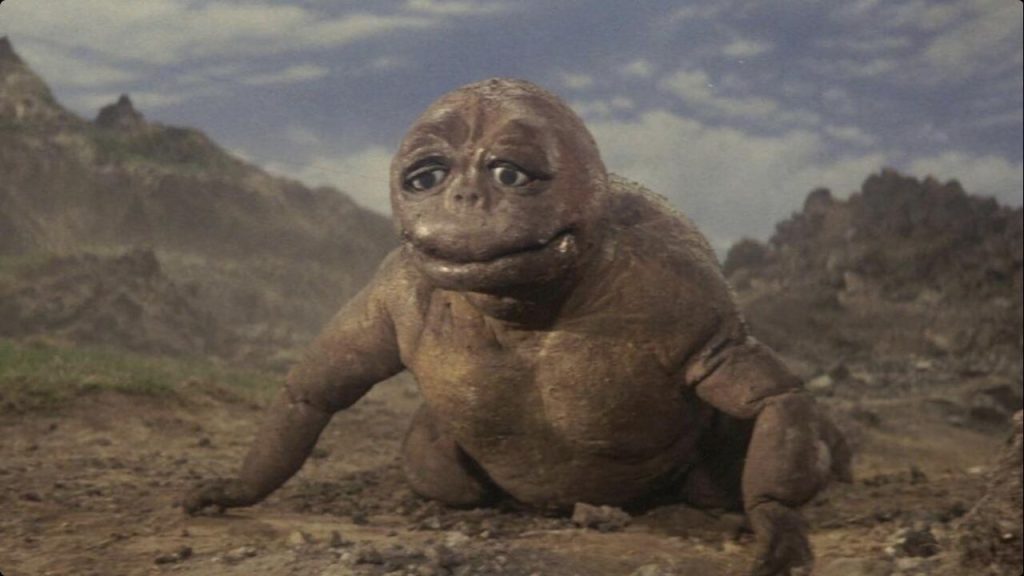
You might ask how he fits into all this. And my honest answer is »Not at all«. For some reason, an egg has been laying dormant on the island. The movie opens on Godzilla tracking a mysterious signal that the egg is projecting. I am grasping at straws here, but the experiments on the island might have triggered an accelerated growth in the egg. Or the signal might be some sort of defensive measure — since the gigantification of the local wildlife causes it to attack the egg. No matter, Godzilla shows up, defends the egg and takes the newly born critter under its wing.
I have nothing but contempt for the creature. I am onset with rapid fatigue any time I look at this gremlin. It drains me to even think about how to describe it. It is an obvious attempt to make my cool kaiju into something cute and comedic. I can recognize that I am probably not the target audience for this, but I still struggle to accept that kids would enjoy this. Godzilla already has the capacity to be a big silly goof ball. Do kids even like this decidedly less cool creature?
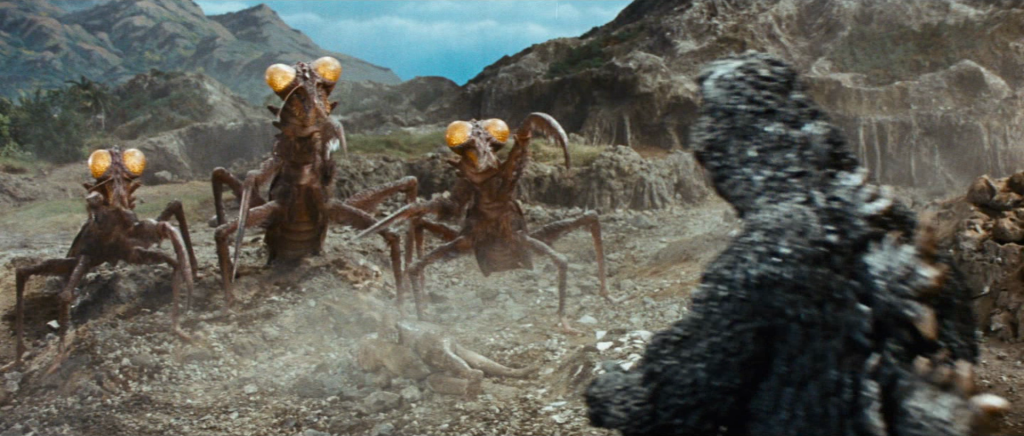
The rest of the movie is taken up with slapstick sequences of Godzilla’ attempts at parenting. It culminates with a giant spider fight, because why not. In the end the researchers manage to escape from the rampaging monsters, by activating the perfected weather machine. The entire island is covered in deep snow and frost — causing Godzilla and his progeny to go into deep hibernation.
So cheers! The machine works and we managed to escape. The movie is seemingly completely uninterested in dealing with the consequences of introducing arctic weather conditions on a pacific island, but I guess this is simply not that kind of flick. And that really stabs at the heart of this movie. Despite highlighting it as a concern early on, Son of Godzilla does not actually want to grapple with the themes it leans on. The final scene is not a solemn reflection on their own hand in events, but cheers at their success. Imagine if the original movie had closed on Doctor Serizawa celebrating the effectiveness of Oxygen Destroyer. To the patent office, I guess?
Son of Godzilla is just a complete flop as a thematic inheritor of Godzilla. Even if it was never meant to be one, it fails even as lighthearted romp. It is one of the worst Godzilla movies and I would recommend to skip it for anyone, but the most hardcore fans.
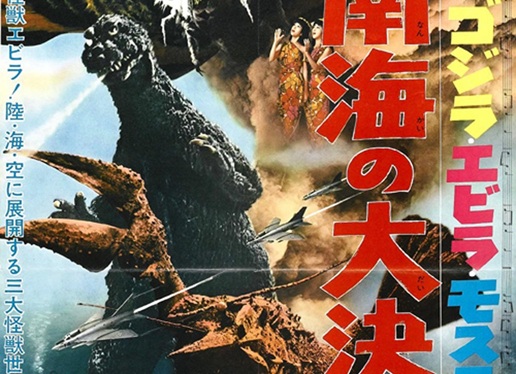
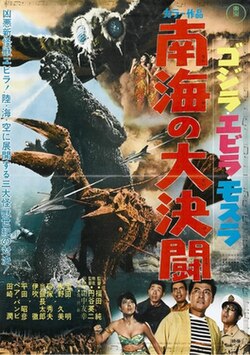
Where is Godzilla? That is a great question, since this was famously never meant to be a Godzilla feature in the first place. Supposedly, Toho had originally wanted to do more with King Kong, after having secured the rights for the big ape back for his 1962 cross feature. For reasons unknown, Toho’s attempts at bringing Kong on the big screen again had stalled — to a point where the rights owners pulled the plug. At that time the studio had been working on a script that was too good to scrap. The solution? Substitute King Kong for Godzilla.
Was it worth saving this movie from the cutting room floor? By the standards of the 60’s, maybe, but I have never held Ebirah in high regard. It was always a low-point in the franchise in my experience. The mood and tone is entirely at odds with what works for Godzilla. I was not aware of the production history of this movie on my first watch. But learning of it certainly makes a couple of things fall into place and my views on this movie have softened over the years.
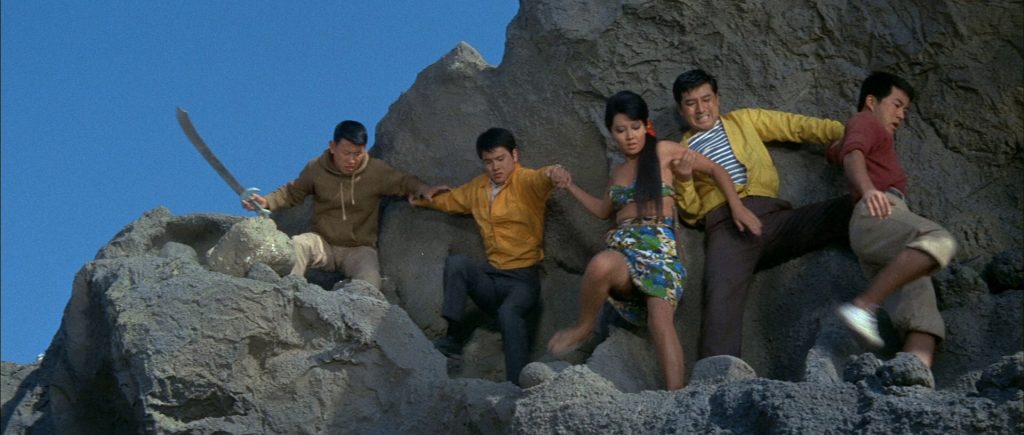
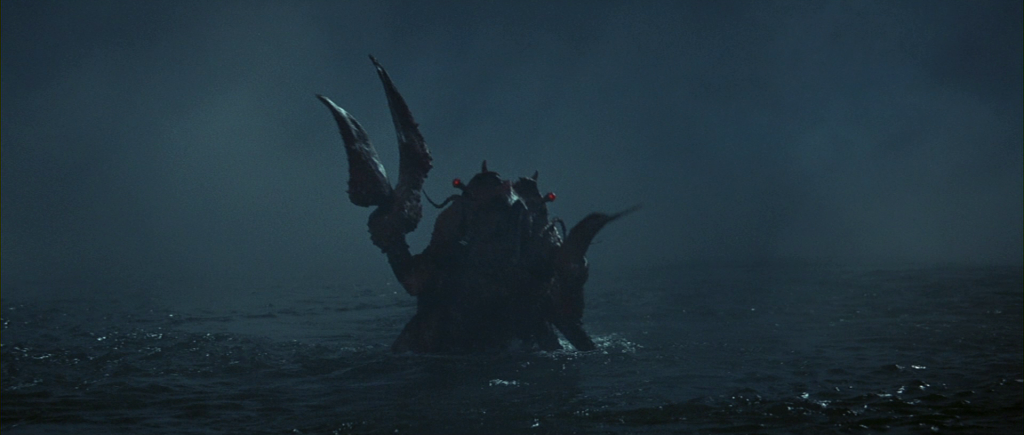
Unlike many Godzilla movies, the plot is entirely character-driven. In a parallel to the ‘54 movie, the story of Ebirah opens on sailors being lost at sea. But unlike the original, one of the relatives left behind decides to take matters into their own hands. A younger brother attempts to charter a boat, and with the help of two friendly city-slickers, he ends up breaking into a luxury sailing boat. In a twist of fate, a sly career criminal has already taken refuge on the vessel. This unlikely crew ends up stranded on a deserted island after a tumultuous encounter with the titular Ebirah — a giant lobster-like monster. As the plot progresses the group stumbles upon secret military installations, an enslaved group of tribal people and a slumbering Godzilla.
If you go into this movie expecting Godzilla, then you are in for disappointment. There is simply not that much atomic lizard on screen here. And even when our big boy wakes up, seeing Godzilla rampage on a mostly deserted pacific island is simply not that fun. This will be a recurring critique from me going on. While it might be cheaper to produce island sets, Godzilla is — at its heart — an urban monster. I do not jump up my couch and punch the air when Godzilla stomps on a palm tree. I need the big fella to destroy the financial district or some big monument.
But if you leave your expectations at the entrance, this movie is not as bad as you might think. For a 60’s adventure romp, it is actually quite nice. The core cast is fun and colourful, while the plot advances at a brisk pace with a satisfying conclusion. Most of all, I think this movie is mainly an artefact of its time. Why would you ever make this movie nowadays? If you are making a Godzilla movie, you would make a Godzilla movie. Not a cross between Robinson Crusoe, Where Eagles Dare and Creature from the Black Lagoon. On its own, I do not think this movie is substantially worse than most of its contemporaries. But why would you watch this? Not as a Godzilla movie. And of all the 60’s era adventure features, why this?
It is a movie that is out of touch and out of time. Not one for a casual Godzilla fans, and maybe even not for anyone, but the most hardcore completionists.
This one has a special place in my heart. It is the Showa-era Godzilla movie for me.
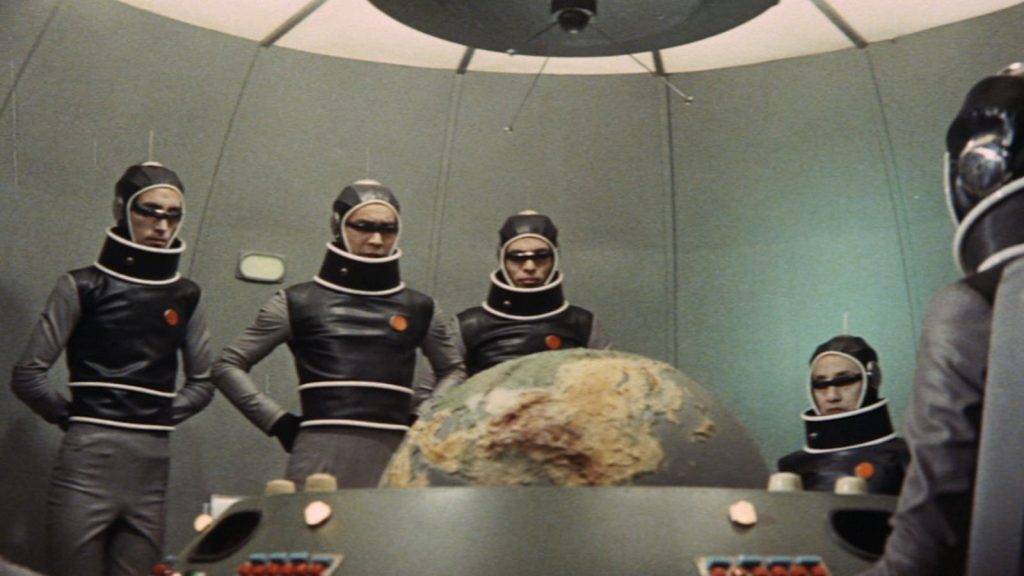
As with the previous movie, we have completed the transition into pure sci-fi. We are in the realm of space missions to hidden planets, weird aliens and intergalactic monsters. This time it works for me though. It is the exact amount of pulp, where I can lean back and let all the blinking diodes and ridiculous costumes beam straight into me.
The difference here is that it is all held together by a plot you can actually engage in, with twisty turns and drama. The central premise of the narrative is the discovery of a hitherto unknown alien civilization on the amazingly named »Planet X«. The foreign planet is ravaged by King Ghidorah, so the local Xians besiege humanity to lend them the strongest monsters of Earth to fight the devastating astro-dragon. In turn, the advanced alien race will give humanity the cure to cancer. Yes cancer. Every time we have watched this movie we are hooting and hollering at every plot development.
With pulp and schlock it is a delicate balance of when something is entertaining and when it becomes too ridiculous. Personally, Astro-Monster threads the needle here, but your mileage may vary.
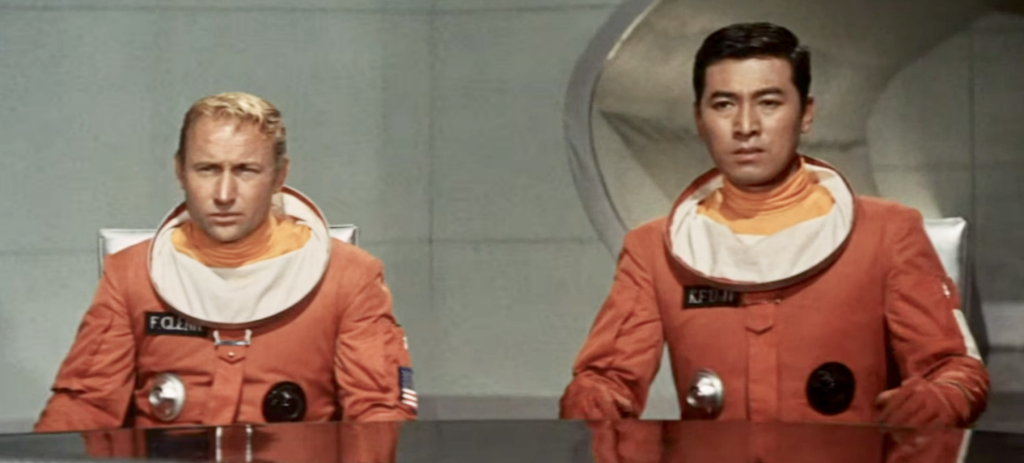
At its core this movie is a surprising buddy-movie. The plot follows two astronauts Fuji and Glenn. They make the initial contact with the Xians and they spearhead the effort in combating them — after the aliens inevitably betray humanity. As protagonists they are proactive and resourceful, something often lacking in the human sideplots of these movies.
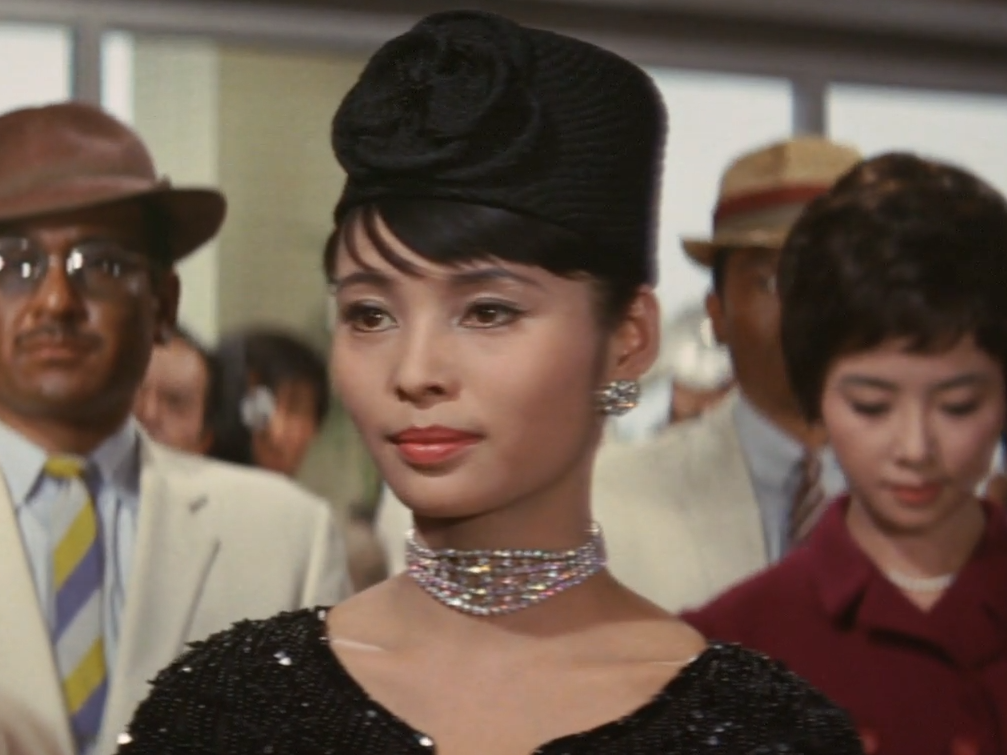
Special mention goes to Glenn. Played by a white actor, speaking perfect Japanese — courtesy of some tasteful dubbing. It fits the 60’s new age optimism that the space mission is a transnational effort, but it never ceases to be funny having a single white guy alongside the overwhelmingly Japanese cast. The comedy is only enhanced by Glenn being an almost James Bond-like figure, driving expensive cars and seducing the hot female alien sent to spy on Earth.
If there is one criticism of this movie, it is that Godzilla itself is put on the back-burner for most of the movie. I do not think our main guy actually has significantly less screentime compared to other movies, but he certainly feels less important. Charitably, you could remove Godzilla from the script and it would not take significant rewrites to fill the holes. That is certainly a flaw with the movie, but I will take that any day over having the main plot be an incomprehensible mess.
People often ask me what Godzilla movie is a good first entry (Yes, they do. Shut up). And it can be surprisingly hard to give a straight answer. The obvious answer would be the original from 1954. It is the best and most prominent Godzilla movie. But it is also, y’know, old. If you recommend a movie from the fifties, most people will look at you disappointed. So, for the less cinematically curious, I go for the modern Reiwa run of movies. Both Shin Godzilla and Godzilla Minus Zero are great movies and easy watches.
But still, do you want to check out a famous monster franchise for an easy watch? Part of the charm is the old-school practical effects and distinct cinematic language. And as much as I like those new movies, they lack that specific aspect. So my compromising suggestion is the Heisei revival title, Return of Godzilla from 1984. It is modern enough to be a fairly frictionless experience, while still fitting square into the core Godzilla experience.
Those are all fine starting points. But, what if you were curious about the schlock? The Showa era’s wacky adventures and silly hijinks is something to be experienced. And here the original ‘54 feature is actually not very indicative of that era. So, where would you go?
For my money’s worth, it is right here with Invasion of the Astro-Monster. It is the height of Showa-style Godzilla. It has the pulpy sci-fi story, monster-of-the-week bash-up and stunt actors in suits slamming down on model cities. It is pure Godzilla, without the common irritations of the era.
While a lot of Showa Godzilla is pretty shoddy, I do not think you can really be a fan without appreciating their distinct flair. And in that regard, this is a personal favourite of mine — a cornerstone of what Godzilla can also be.
I like pulp. I have a high capacity for sense-making. If a piece of media is cool or interesting enough, then I am generally not bothered about the details. This, of course, depends. Some narratives are incredibly coherent and well-thought out, making them fun to consider. Others are not.
At my core, I am a doylist. More often than not, the most compelling answer to »Why did X character do Y« is simply »Because otherwise the story does not make any sense«. For some this is a dealbreaker — an irrevocable snap of their suspension of disbelief. I am sympathetic, but I guess I am just built differently. If the core appeal of something is looking cool, I can completely detach myself from the in-universe explanations and focus on the cool-factor.
I would attribute this to growing up on foreign media — video games and comics. But I am honestly not sure. Do poems make sense? Surely not, beyond the emotion they evoke. But is that not just another form of sense-making? Being able to grab hold of the unformed creative mass of a work and shape it into something that makes sense to you — to me that has always been the most powerful way to engage with a piece.
My girlfriend joined us for one of our watch sessions where we saw the two next Godzilla movies. She had never seen any of them. I reassured her that one of them would be »one of the good ones«, and that the other would be »a real stinker«. On our way home she cautiously stated that she could not tell the difference.
Sometimes it is great to see something you are familiar with together with someone who is not. You get to experience it through their eyes. And at that moment I could kinda see that while I love Invasion of the Astro-Monster (1965) it is not fundamentally different from the schlock that is Ebirah, Horror of the Deep (1966). The real difference is that the former lights my imagination while the latter douses it. It is not the acting, the narrative or the sets. The difference is the creative vision — which is altogether a much more ethereal thing to get a grasp on.
I consider myself a homegrown Godzilla fan. I have watched all the movies — multiple times even. But I have little exposure to the wider fan community. I am not even sure whether there is a singular community or whether I am just presuming based on my limited contact. One of the reasons why I have not sought out my peers is because I am staggered by their bad opinions. Yes, yes — I too am a curmudgeon who cannot let go of my thoughts on Godzilla movies. Surprise, Surprise.
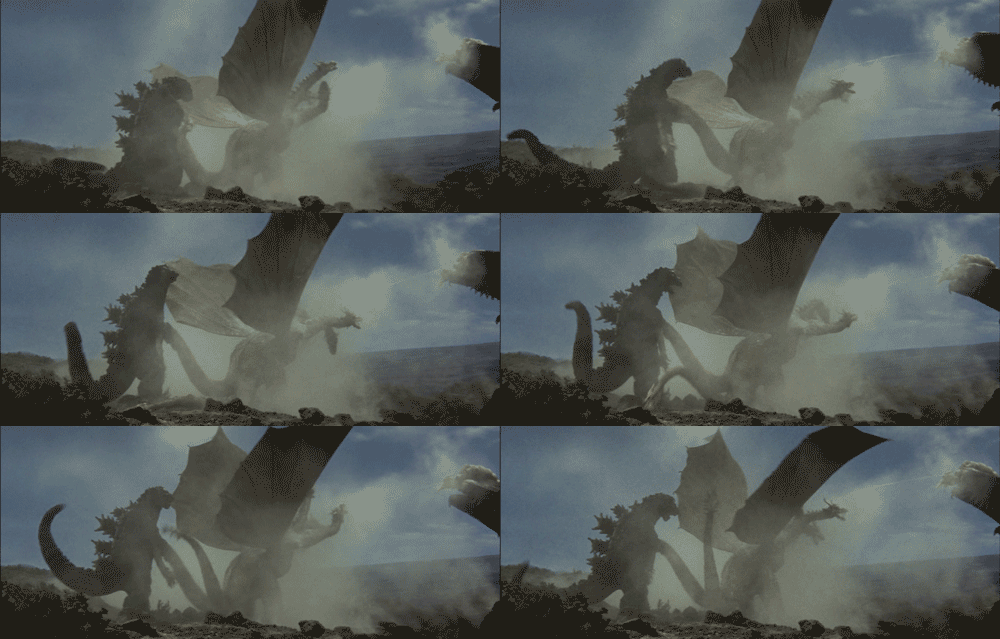
Apparently, so-called Godzilla fans love Ghidorah, the Three-headed Monster (1964). It is the quintessential Showa era monster mash-up. To me it is the herald of the worst of the worst when it comes to Godzilla. The plot is flimsy, the monsters silly and altogether it just does not work as a movie.
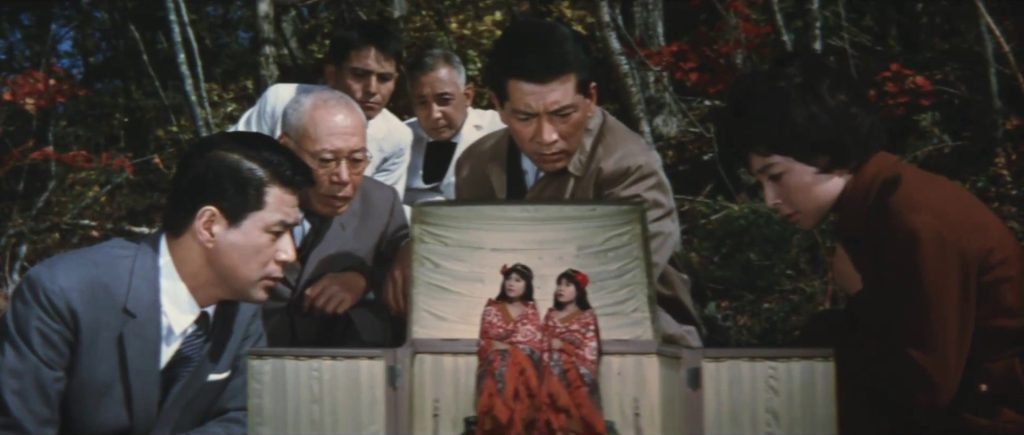
The hook for the narrative revolves around a foreign princess who goes missing. There is an unexplained plot against her life, complicated by the fact that she seems to be possessed by an ancient Jovian entity. The princess warns the people of Earth that her home planet was destroyed by an inter-galactic monster — the titular three-headed dragon, King Ghidorah.
I do not have a problem with King Ghidorah itself. The monster is cool enough and is a fitting escalation for Godzilla. The big lizard has thrown down with the best the Earth has got. Seems fitting the next matchup would be from beyond the stars. My issue is more with the tonal shift.
The conception of Godzilla sprang from the well of speculative science fiction. The premise was »what if this real life thing had unintended consequences?« Some of the weirder and non-scientific elements I can write up as new ageism. But to me, this movie crosses the line over to complete sci-fi schlock. I do not mind pulp, but the elements in Ghidorah simply do not coalesce into anything worth engaging with.
The plot with the star-possessed princess goes nowhere. For all the screentime dedicated to her plotline, its relevancy can be summed up as warns the Mothra-fairies → Mothra recruits Godzilla and pals to fight Ghidorah. While other Godzilla plots were also simple, there always were some core themes or messaging you could engage with. The rise of new technology, the exploitation of nature, the innocence and guilt of mankind.
Okay, but who cares about the plot in a Godzilla movie? We are here for the monsters. Yeah well, it sucks. There is no gravitas, no weight to the battles. The cool thing about giant monsters is primarily that they are giant. Here they play tennis with styrofoam rocks. It is just not cool.
And so there really is not much else to say about Ghidorah, the Three-headed Monster. It is a movie solely concerned with its four-way matchup, but the fight itself sucks. And that is the crux of the matter for me. I can disregard otherwise flimsy plots if there is at least something to grasp hold on. And I can look past bad visual effects and choreographies if the action is at least cool. But there is simply neither at display here.
It is not just a bad movie, but a bad Godzilla movie. Why? Because it does not light my imagination.
After King Kong vs. Godzilla (1962) showed the applicability of Godzilla as a frame for monster mash-ups, there really was no turning back. The Showa era would see Godzilla turn from tragic symbol, to stock element a producer could throw into a production to increase viewership.
These early Godzilla flicks are concurrent with some of Akira Kurosawa’s greatest works. Titles like Ikiru, Seven Samurai, I Live in Fear, Yojimbo, High and Low all released alongside Godzilla’s increasingly silly adventures. If your only exposure to Godzilla are the stories about its origin as a nuclear metaphor, you might expect the movies to be rather cerebral affairs. But reality is that most Godzilla films are incredibly schlocky experiences that are exactly as intellectual as you would expect from stories about giant monsters duking it out. I resist the impulse to broadly label these movies as »bad« even if they have that unmistaken B-movie vibe. While there are a good handful of Godzilla titles that provide food for thought, most of them are unmistakable cheap thrills.
Movie culture today is simultaneously inconsequential as a common cultural frame, yet still built upon massive expectation. Even movies that are arguably primarily about low-brow entertainment need to be these massive cultural events. For a good while I saw news reporting on the casting choices in Marvel movies like it was national leaders getting elected. The unsettling trick of those movies was that you did not just watch a movie — you entered a cinematic universe. You were invited into caring about the corporate planning of a media giant and view storytelling as a means toward this nefarious, big thing. It was a wave that continuously crashed over you till it had chiseled you down to a smooth surface. No one made Ant-Man and the Wasp: Quantumania because they had anything to say. The studio needed 124 minutes to open Phase 5. The significance of phases is something I was implicitly expected to understand.
Movies in the 60s were probably not hyped to be the seismic cultural events that a major movie release is today. But, digging into the making of these Showa-era Godzilla movies, there are some remarkable similarities. Seemingly, the studio would look at their production schedule and see a slot that could be filled with a Godzilla feature. They would collect story pitches from their workers and freelancers, pick the most interesting and task one of their staffed writers to turn it into a script. The movie would then be assigned a main director and — for effects-heavy movies like these — a separate director for the VFX-sections.
While these early entries in the series were primarily helmed by Ishirō Honda and VFX director Eiji Tsuburaya, that does not mean that they are auteur movies. While Honda definitely had a strong influence, my impression is not that he had the same level of artistic input as a director like Kurosawa. While Godzilla is inarguably his claim to fame, Honda has a distinct workman-like attitude toward the movies. The movies were largely assignments and it seems like he treated them as such.
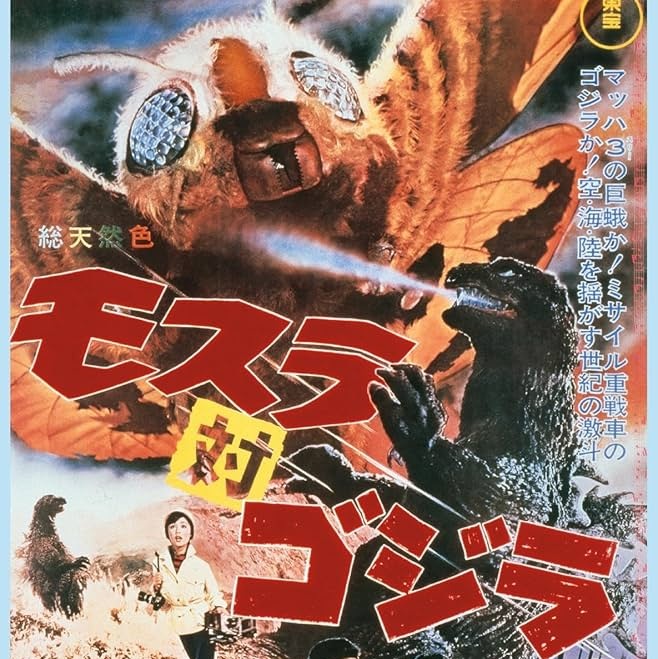
This is a long, roundabout way of saying that Mothra vs. Godzilla is the first Godzilla movie that really feels painted by number. It will not be the last either, but it is apparent that the studio had the Godzilla and Mothra suit lying around, with an open production slot to fill. That is the bottom line really. It is a crossover movie between Mothra and Godzilla — exactly as advertised.
The divine giant moth will become a main player in the series going forward. And I remember being excited about the movie my first time around. Because, this was the genesis of an iconic foil to the atomic lizard. But today I am left with a single thought.
Mothra kinda sucks.
Sorry to the Mothra lovers out there, but it is simply neither a cool looking monster nor interesting conceptually. The problem with the match-up is intuitively apparent. How the hell does a moth fight a dinosaur? And the answer is: in a contrived and dumb way.
There is also a less obvious issue with the crossover. The themes of Godzilla and Mothra — while seemingly congruent — becomes a mangled amalgamation that works against the movie. What I enjoyed most in this movie was the initial plotline. Mothra’s egg washes up on shore and greedy moneymen immediately seizes the opportunity to exploit the situation. There is a strong core cast, with a trio of main characters: a hardworking journalist, his plucky female photographer and an aloof researcher. Their attempt at preventing exploitation — and later beseeching Mothra’s aid against Godzilla — is compelling. They are the strongest protagonists in the Godzilla movies so far.
In a funny way, the villains’ treatment of the egg forms a clear parallel to Mothra and Godzilla as pieces of fiction. They too have been reduced to property that needs to turn a profit.
Where the wheels come off for me, is when the trio travels to Mothra’s home — Infant Island. The place is inhabited by a tribal community that worships Mothra as their protector. The surrounding environment was desolated by nuclear testing and now the only greenery left on the island is Mothra’s sanctuary. This is a clear parallel to Godzilla’s own origin. My memory of Mothra(1961) is hazy at best, but in that movie the oversized moth raged because its twin, psychic fairies were abducted and forced to become media celebrities. That movie was a warning against the commercialization of the unspoiled. The fairies are both infantile and foreign to industrialized society. They work as stand-ins — both for children and indigenous people. They are disempowered and ripe for exploitation, which in turn leads to divine retribution in the guise of Mothra.
But in Mothra vs. Godzilla the divine moth is a force for good. Despite the greedy capitalists attempts at exploiting it, the protagonists beg Mothra to save Japan from Godzilla. The islanders angrily refuse. Even the benevolent fairies agree that the outsiders brought the destruction on themselves. And here the themes come apart for me. The tribal society solely wants to protect the last speck of unspoiled nature, and if it was not for the unexpected grace of Mothra, that would be the end of it. The conflict has no resolution. The greedy capitalists do themselves in. The heroic trio does not have to make tough decisions or come to term with anything on their end. The islanders are being made to be correct about their hostile isolationism. At this point the plot simply breaks apart and only picks up because the giant insect decides that gosh darn Godzilla needs a good walloping.
Despite my gripes with the narrative, I will say that the pacing is unusually good for one of these movies. There is a clear three act structure, with a dramatic initial showdown between the two titular monsters. Mothra is defeated, only for its larvae to emerge from the egg in time for a rematch at the climax of the third act. This movie also settles into unsatisfying trend. As part of the serialization of Godzilla as a franchise, the big lad can never be killed off for real. Godzilla always needs to be ready for the next movie, but it has firmly been established that it is nearly indestructible. So how do you deal with it as a narrative threat? Well, after getting silked up by Mothra’s offspring — Godzilla falls off a cliff and the movie ends. Calling it unsatisfying would be an understatement.
I have warmed up to King Kong vs. Godzilla over the years. This is despite the fact that a lot of similar critique could probably be lobbed its way. But the key difference to me is that while King Kong vs. Godzilla feels infused with a reverence to the idea of the match-up — Mothra vs. Godzilla comes off as decidedly manufactured and sterile.
This movie writes itself. We take their biggest monster and put it in the ring with our biggest beast. It is a perfect setup.
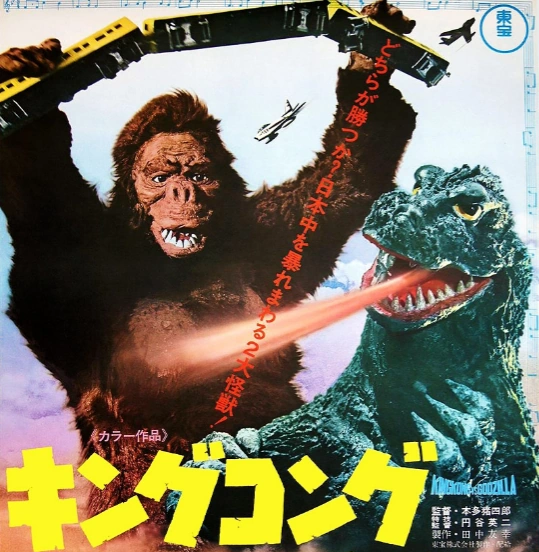
King Kong vs. Godzilla (1962) is iconic. Not just because of the star power of the two titular kaiju. It is the sheer indulgence in making a movie that’s just a pretense to bash your two favorite toys together. The concept of a monster mashup was not invented here. My movie-watching comrade helpfully informed me that FrankensteinMeets the Wolf Man (1943) predates it at the very least. And to be honest, I do not claim to be a film scholar. I have zero clue if that is the first or not either.
But King Kong and Godzilla. There is just something more to these two. Something grander. Part of the charm is what these two represent. The makers of Godzilla have stated in interviews that seeing King Kong (1933) for the first time evoked that feeling of »Wait, you can do that??«. The impetus for making Godzilla in the first place was to walk the road that King Kong paved, giving it a japanese twist while updating it for a modern audience. So instead of stop-motion Godzilla was made with lavishly built suits and meticulous model sets.
Fittingly, King Kong vs Godzilla feels like a love letter to this one movie that really inspired the creators of Godzilla. It honestly has more in common with fanfiction — if not in production, then in vibes alone. There is a reverence for the namesake that is almost touching. A thing that trips me up with this movie is the title itself. It is King Kong vs. Godzilla and not Godzilla vs. King Kong — the only Godzilla feature that does not put our atomic pal in the forefront.
The main plot of the movie is almost a parodic retelling of the original King Kong. Two bumbling Japanese salarymen are sent to Kong’s Island in order to create a promotional stunt for the pharmaceutical company they work for. Through quick wit they manage to capture Kong and bring the ape back to Japan, but something naturally goes wrong. Kong’s escape luckily coincides with Godzilla breaking free from its icy prison, setting the stage for the matchup of the century. While the plot is quite silly on its face, there’s a jovial 60s charm to the whole affair. Gone is the existential dread of the 50s. Here in ‘62 there is no problem that cannot be resolved with a clever ploy and some improvisation. It gives the movie a decidedly innocent feel that is in stark contrast with what came before.
The main issue with the plot is frankly the rampant racism on display. Scenes on Kong’s home island are filled to the brim with Japanese actors in black face. I would feel amiss if I did not point out that this is some old-school racism, but I am not sure I have anything meaningful to comment, other than it sure puts a damper on the enjoyment of watching the movie.
Along the way, key scenes from the original King Kong are recreated with no hint of irony. Seeing Kong kidnap the main protagonist’s sister and climb the not-that-tall National Diet Building is more laugh-inducing than dramatic, but it is played completely straight. Again, it’s almost charming how enamoured the creators were with the idea of this movie.
The veneration is even extended to the fight itself. This setup is rife for the time-honoured tradition of nerdy kids arguing online of »who would win?« And I am not immune to some good ol’ debate about powerlevels. And look — let me level with you here. On paper there is not much of a fight. While its proportions are pretty inconsistent — King Kong is at best a measly 15 meters. And the big ape does not have much else going on for it beyond its sheer size. In comparison, Godzilla towers above the puny primate with its massive height of 50 meters. Just the sheer difference in weight class should be enough to put my radioactive boy one top. But just to rub it in, Godzilla comes equipped with a destructive atomic breath enabling long-ranged attacks that Kong simply has no real counter for. Famously, King Kong was bested by pathetic man-made weapons, whereas Godzilla was impervious to anything the army could throw at it.
All I am saying is that the deck is kinda stacked here. For this reason the filmmakers wisely snuck in some much needed upgrades for Team Ape. Firstly, Kong is scaled up considerably. Secondly, the plot gives the hunky gorilla a newfound connection to storms. First time watching the movie we threw up our hands in exasperation when Kong — at the edge of defeat — was resuscitated by lightning. What an asspull! But on a rewatch I gotta admit that this is actually established quite well in the plot itself. Oh well.
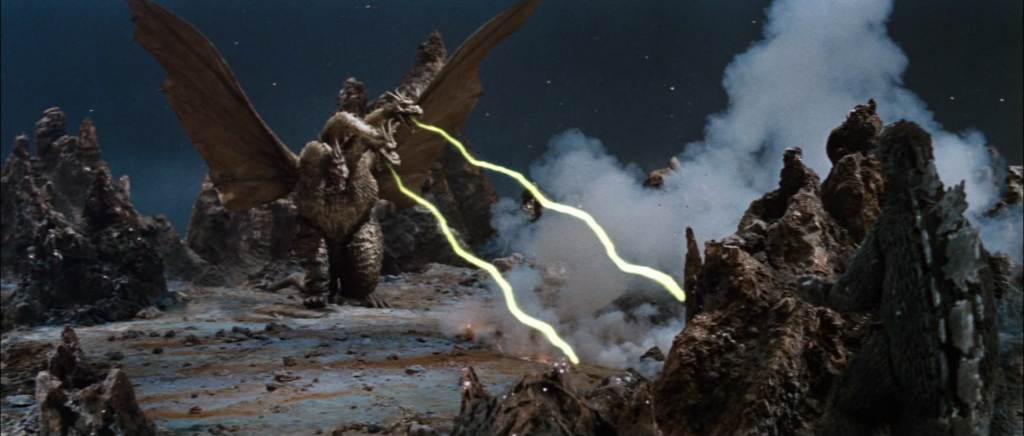
The coolest part of the movie is arguably also this moment where a reinvigorated Kong pummels Godzilla with lightning induced strikes. I cannot tell you how that works, but it sure looks cool. I think I read somewhere, that at some point in the production, Kong’s part was initially intended for Frankenstein. The connection to lightning is supposedly vestige from that — although do not hang me up on that.
Something that is immediately apparent going from two prior movies is the jump in time. Gone is the classic black & white look, and in is the warm embrace of technicolor. While the original from 1954 was beautiful in its own right, the jump to colour and a widescreen format definitely gives this movie a more cinematic flair. There is especially something about the colour palette that really sells the everyman adventure fantasy and gives the movie a welcoming mood.
Ten years ago, I remember being utterly unimpressed by the special effects. For example: at one point there is a scene where the image of an octopus has simply been projected up on screen in front of a bunch of extras. But on this rewatch I will admit to actually buying the effect this time — maybe due to the quality of the version we got our hands on. The only sleight on the looks of the film is that the visual fidelity is highly inconsistent. I am not sure if this is because of the version we watched, but shots would fluctuate between looking crisp to grimy within the same scene.
At some point the movie decides to end. That is how it feels to me at least. After a final exchange of blows King Kong and Godzilla tumbles off a cliff and credits roll. My best guess is that our two main fighters both had it written in their contract that they could not lose, because it is extremely anticlimactic. In the end King Kong vs. Godzilla is not my favourite Godzilla flick. To be completely honest, it is a rough watch and more interesting than entertaining. But I think it is worth a watch, just for the audacity of the premise and the gung-ho way they decided to make it real.
The first time I set out to watch Godzilla, I remember wondering how long it would take for the series to forget the sombre tone of the original. Well, you do not need to wait long, because a year after they made Godzilla Raids Again (1955) and it is deeply silly in comparison.
It is not the whimsy that would come to characterize the Showa era Godzilla movies. While Godzilla (1954) feels grand as a movie production, Raids Again feels cheap. It comes off as a case of »Well, we spent money on the suit, might as well reuse it«. Everything is scaled down compared to the original. Less sets, less characters, less narrative.
The plot follows a pilot for a private firm that does… something? He flies around the ocean with his best buddy and wingman — while his fiancee back at the head office works as a radio operator. Her father is the boss of the company, and that setup seems like it would be a springboard for all sorts of dramatic scenarios that simply fail to manifest.
I will be honest and say that the plot itself has always been quite hard for me to follow. Not because it is complex — but by being both staggeringly boring and kinda inconsequential. Watching Godzilla films as a non-Japanese speaker, you do run into a slight disconnect from the language barrier — which is only amplified by being made a generation before I was even born. Most of the »human plot« of Godzilla movies are based on dialogue. Watching actors stand around without doing much other than talking, means it is harder to pick up on contextual clues.
So I will admit that there might be nuances of the plot that eludes me. We could never quite figure out if the main trio were wrapped up in a subtle love triangle or if everyone was just acting awkward. At the climax, the best friend dies from what seems to be an heroic sacrifice — again, it can be a bit hard to tell. A plot element like that feels like it should have some narrative resonance, but it is hardly commented on in the script.
Something important that this movie does teach you as a fan, is that continuity between entries was never a big focus for the series. While there is not anything that directly contradicts the first movie — they even bring back Professor Yamane for a short scene to bridge the gap — there is made no effort into qualifying this as a continuation of the previous story. Why is Godzilla back you might ask? Did the monster not famously die at the end of that movie? Was the entire moral dilemma of the third act not dependent on killing off the creature for good? So how is it back again?? Well, there is an easy answer to that.
There was a second Godzilla.
A contributing factor to the cheap feel of the movie is the staggering amount of stock footage. The 1954 original used what is clearly archival material from the Pacific War — something I have always found to be part of the je ne sais quoi atmosphere of that movie. But here it is just laughable. When the exact same shot of a squadron of fighter planes is shown three times back-to-back, you are not drawn to the historical context of the production. You just think »Damn, they were really running on a shoestring budget here, huh«.
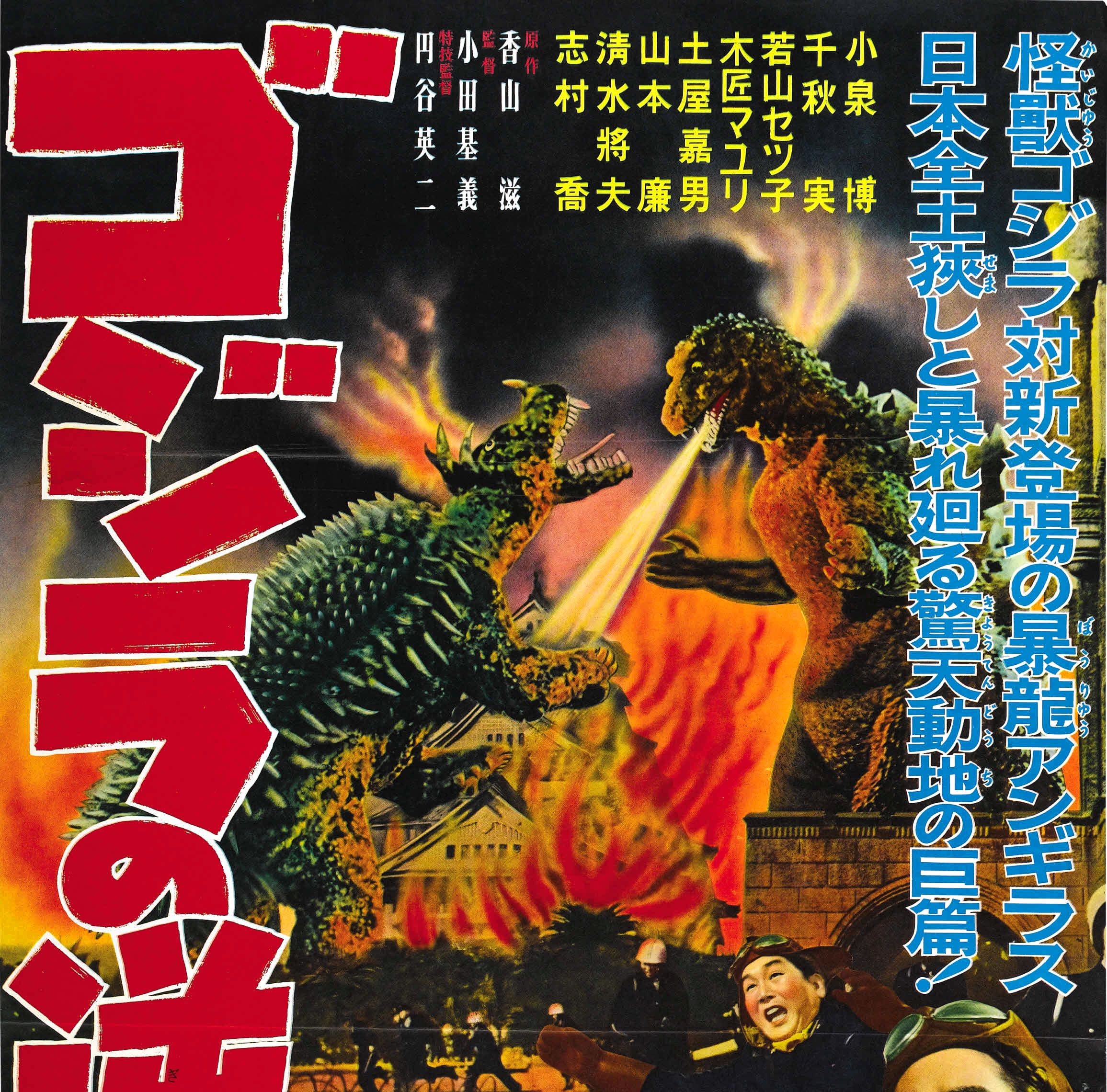
The only cool part about this movie is the introduction of another giant dinosaur monster — Anguirus. You might ask why there is another giant monster rampaging around, but this is treated with the same handwaving as Godzilla’s return. The movie makes it clear that you do not need to care about hows and whys. You are here for the spectacle and not much else. And for what it is worth, the best part of the movie is the spectacle. Seeing Godzilla and Anguirus go at it is entertaining — although coming off as crude compared to what is to come. And ultimately, Anguirus is just another ill-fated part of the movie. I forget it is even here, because his appearance makes no impact on the plot.
Part of what sours me on Raids Again is that it is utterly dependent on the first movie to be dramatic — but its own climax is entirely divorced from it. At the end of the movie the army manages to bury Godzilla alive in an icy grave. While they might not be able to kill it, they find a way where they can bomb the issue away. Praise be for our boys in the JSDF!
There is not an overt jingoism to be mad at. Raids Again just seem completely unwilling to engage in what made the first movie interesting. If they had not kept making more movies, this would ironically be the movie that killed off Godzilla.
Raids Again is not the worst Godzilla movie, but it is the most inconsequential. Should you watch this movie? Only if you are really curious about the history of Godzilla, because if the big guy had not been in this movie, I do not think anyone would remember it.
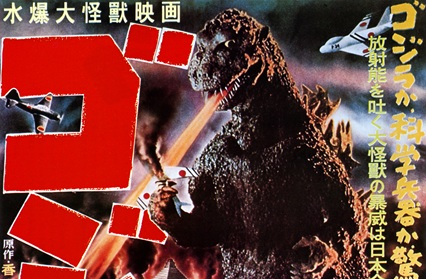
Godzilla is one of those ethereal pop culture icons. I got into the movies explicitly to get into it — to learn what the big deal was. Godzilla is the archetypical kaiju, the platonic ideal of a big-ass monster that rolls into Tokyo to destroy skyscrapers. Just from pop-cultural osmosis most people probably understand the deal intuitively, without ever having watched a single Godzilla flick. But they have made like 30+ of these movies, it can’t possibly be as simple as that — can it? So exactly 10 years ago, I sat down together with a friend of mine to actually do the legwork. Watch every Godzilla movie in release order and see how this beast came to be.
What you quickly realize is that Godzilla is less of a movie series and more of a genre on to itself. Godzilla as a monster is not really a character — more of an action figure you can throw into a movie script to shake things up. From a sinister force of nature to a jovial defender of Earth. There is no set “true” nature of the atomic lizard. A clear tell of not actually having engaged with the movies, is claiming a depiction of Godzilla is unfaithful. For all the criticism you can lob at the American made Godzilla movies, them being at odds with the tone of the original movies is not one of them. The notion that Toho produced these cerebral pictures that were all about the horrors of nuclear warfare is simply untrue.
From their earliest incarnations, Godzilla movies are about guys in rubber suits getting shot at by model tanks. Even when the subject material is dark, there is always an inherent silliness to the endeavour. What makes it work is that the filmmakers never shy away from it. The special effects are not hidden away, made to be as imperceptible as to not take away from the action or plot. No, it is right there in your face. Seeing the seams is part of the charm.
I have not delved into the wider Tokusatsu genre, but from what I can gather it has a similar energy. It is like professional wrestling in that sense. If you buy into the premise from the get-go, you are free afterwards to lean back and enjoy the ride. You watch Godzilla to see a big fucking monster run amok. So when Godzilla destroys a large building you cheer like if he had dropped an elbow from the top rope.
As I have gotten older I am less able to get pumped up by depictions of wanton destruction. Something in the back of my mind cannot help but think of how much it would cost to rebuild a modern city. How many people are left homeless or without a job after the villains are defeated. It is a dumb part of adult life never to be able to set your mind free from the necessities that arise from needing to live and breathe in a material world. But I can kinda let my shoulders down with Godzilla, because it is so easy to look behind the curtain. I still cheer at the special effects and awe at the intricate model sets — maybe even more so because I have been lifted of the burden of judging whether or not it looks real enough.
The sole exception is actually this movie. I have gone from thinking »How are they going to be able to rebuild that?« to »How did they rebuild that?«. Tokyo getting demolished has almost become a trope at this point. But there is a sting to it in this movie, because of the knowledge that at this point they have just finished removing the real-life rubble. Knowing the movie was made right after the allied occupation of Japan ended, certainly colours how you engage with the motifs of the movie.
Godzilla (1954) is arguably the most distinct entry in the series. Here on my second rewatch, I would even go as far to say that it is hardly a Godzilla movie at all. In every entry except this one, Godzilla is treated with a reverence and mythologizing that is completely absent from this incarnation. The titular monster is hardly the focus plot. There is nothing inherently special about Godzilla in this movie. It is for all intents and purposes just a monster — a product of the hubris of man.
What caught my attention on this rewatch was how much time the movie spends on completely regular people. When I try to recall the plot of this movie, my mind immediately goes to the two scientists, the young and tortured Dr. Serizawa and the melancholic paleontologist, Professor Yamane. Together with Yamane’s daughter and assistant, I had thought of those four as the core cast of protagonists, but that is hardly the case. Sure, they take up the primary screen time in the back half, but they are mostly absent for most of the runtime.
The opening of the movie depicts a mass of relatives to missing fishermen — demanding the authorities to do more to find the cause of the disappearances. And when Godzilla rampages through local islands to metropolitan Tokyo, we are not seeing it through the viewpoint of plucky protagonists, but completely regular citizens. The parts of this movie that really strikes a chord are these snapshots of mundane people with no attachment to the larger plot. A particular memorable scene is a small moment where a mother is holding her children. As Godzilla destroys Tokyo she tries to to calm them down. In their final moments, the mother tells the children that soon they will be reunited with their father.
This is not a random remark to pull at your heartstring in a tense moment. A lot of attention is put on the people left behind. As said, the initial horror of Godzilla’s awakening did not come from the people on the attacked boats, but from their families on shore, desperate to find out what happened to them. On the small island where Godzilla is finally tracked down, a emphasis is put on a boy who loses his home and family due to Godzilla. The boy is then used as a witness to the government on the existence of Godzilla. And in another movie, that would be his sole function in the plot — exorcized from the script thereafter to tighten the viewers attention on the immediate plot.
But in this movie, the boy gets adopted by the Yamane household and sticks around — seemingly for no real purpose. When I first watched this movie, I found this hilarious. It seemed like such an odd detail to keep having him there in the background in pivotal scenes, but with no lines or real role to inhabit. But that is — of course — entirely the point. The destruction of Godzilla is only made significant because of those left behind to live with the aftermath. If everyone was killed — if there truly was nothing left — then it would not be scary at all. There would only be nihilistic emptiness.
Part of the reason why the depictions of survivors hit so hard is the knowledge that while Godzilla is fictitious, the people on screen are not. It is hard to ignore that this movie was made hardly a decade after the Pacific War ended — an event that would have felt apocalyptic to many Japanese citizens. There is melancholia that emanates from Godzilla (1954). It does not wallow in the horrors of destruction, but instead there is this ever-present sense of sadness and loss. Part of the tragedy of the movie is the need to kill Godzilla. Kill a wonder of the ancient world, the last survivor of a lost age.
A turning point in the movie is Professor Yamane falling into a stupor caused by his objections to killing Godzilla. He argues in favour of studying the beast, to turn Godzilla from a disaster to an opportunity to further the knowledge of mankind. But with the mounting casualties he is shot down. People are dying and you want to turn it into a research project? Yamane does not even have a real counterpoint. What inherent value that could be found from keeping Godzilla alive crumbles in face of the abject loss of human life. So he withdraws to his room, wallowing in self-pity for not being able to stand up to his ideals, lashing out against the people around him.
It is a haunting portrayal of the hollowing that war brings. The true casualty is not lives lost or material damages, but the loss of our capacity to work for beauty and good. What does abstract ideals matter with survival on the line? And so, the final dilemma of the movie is presented through Dr. Serizawa. The haunted scientist has invented a tool with the capacity to kill Godzilla, but at what cost? Godzilla itself is the product of technology that was similarly used to solve a do-or-die situation. Out of the atomic bombings a literal monster was born. Will the solution be another figurative bomb? Will we have to keep inventing bigger bombs to solve the troubles they birth? The reflection of this tragic cycle is part of the deep melancholia of Godzilla and what elevates it from a comparatively simple monster movie.
In the end, what motivates Dr. Serizawa to use his invention is not the rational arguments of his peers. My friend noted, that what actually convinces him is not the principal characters, but the unknown masses. At the pivotal moment of the climax, a broadcast is made of a school assembly, singing a song of peace. While adults are wrapped up in all this bullshit, the children are not. Godzilla was not just born out of the atomic bombings. What caused the monster to rise, was the continued test bombings that disturbed its natural habitat. The Japanese government itself inadvertently ends up attracting Godzilla to its shores by provoking it. Might the tragedy have been avoided if the authorities had been less hellbent on seeing Godzilla as an obstacle to be removed? Serizawa’s rejection of the cycle comes at an ultimate cost. When the invention is deployed against Godzilla, he sacrifices himself in the process. With his research notes gone, so is the possibility of recreating the technology — along with any good it might have been able to herald in a better future.
Godzilla as allegory for the atomic bombings is common knowledge. But as any good thematic motif, it is not as simple as thing=bad. Godzilla is a cautionary tale — not just of the horrors of war — but of seeing the world as a series of nails that needs to get hammered down. As a collection of problems that can be solved by dropping bombs on them. Even if it is foolhardy, moronic and out of touch with reality, insisting on what is good and beautiful is the only thing that will truly save us.
And what touches me watching Godzilla (1954) is precisely the sad realization that we are still trapped in that cycle — that we are still led by people seeing the world as problems to be hammered down. That bombs are still the ultimate solution when all else fails.
But this movie was made — grand and beautiful as it is — by people who lived through the bombs. And if they could keep hope for a better tomorrow, then so can I.