Esoteric Ebb is a highly enjoyable narrative-heavy RPG — the type of game that has become colloquially known as a »discolike«. The main creator of Ebb — the Swedish solo dev Christoffer Bodegård — has happily invoked the term himself, as a descriptor for the style of his game. As a massive fan of Disco Elysium, I’ll admit that it was this comparison that initially drew my attention to Ebb. Despite actively being on the lookout for a successor to the 2019 hit RPG, this had not been on my radar at all until a demo dropped with good word of mouth.
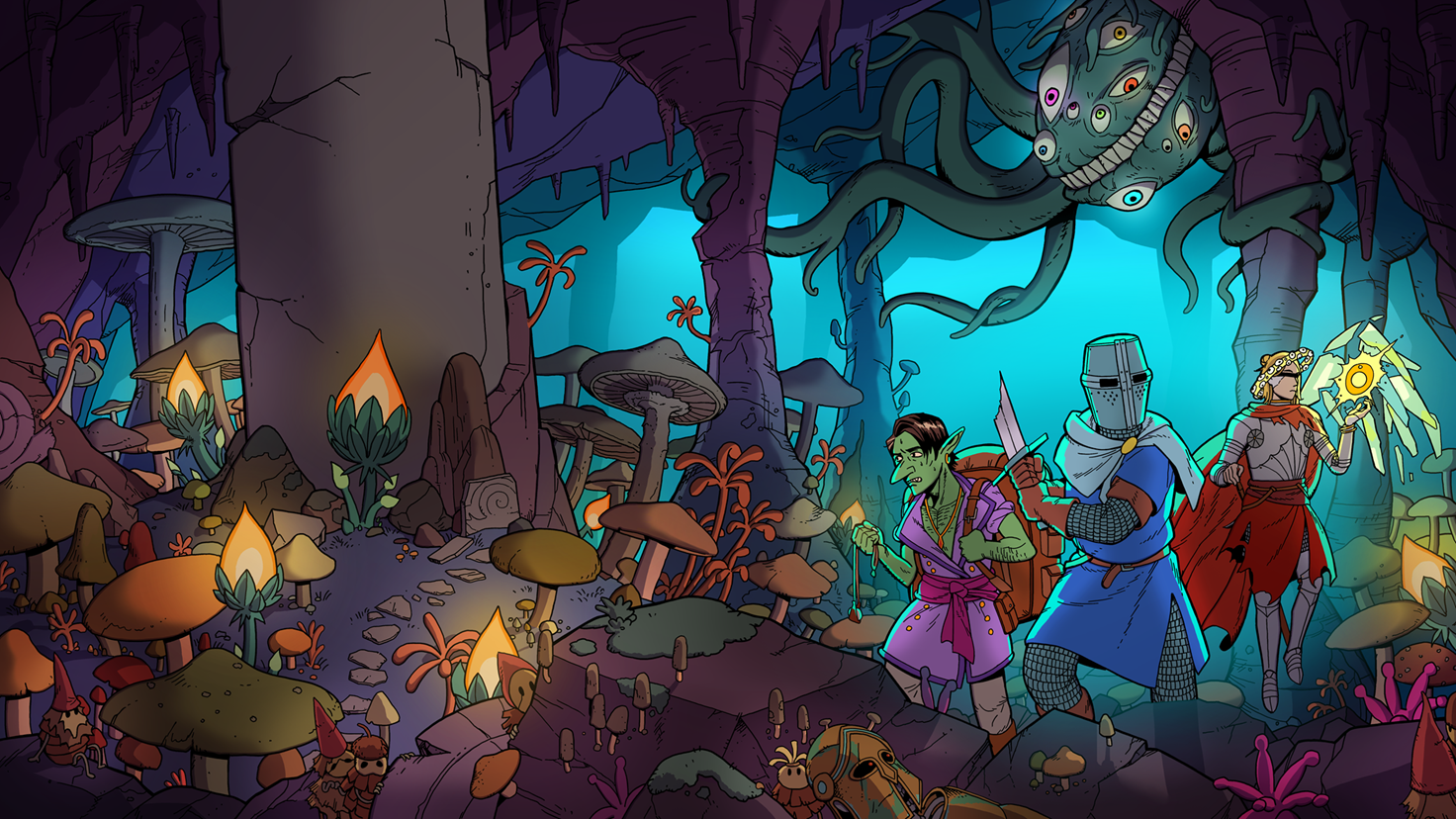
And Esoteric Ebb makes a great first impression. The art style is charming and the elevator pitch for the plot is sleek and enticing:
»The first ever election is in five days and a tea house has just blown up. The city is sending its worst cleric to find the cause. They send you. «
It is a great setup and the promise of an esoteric adventure about political intrigue in a kitsch fantasy setting got me stoked.
But here is the thing about Ebb. There is a steep drop-off from the first to the second impression. When you hit New Game you’re hit with a character creation screen where the standard D&D attribute array has been restyled as figments of your personality. Okay sure — your skills speaking to you in their own voices was a highly recognizable part of Disco Elysium. No harm in giving that another spin.

Then the game starts properly in a dark void with a disembodied voice. You wake up in a morgue with no clue on how you got there — gotta pay your dues to Planescape Torment. The locals are mad at you for being late and you’re handed a straight-faced partner because of jurisdictional issues. This is all eerily familiar, because it is beat-for-beat Disco Elysium. You have even lost your gu- erhm spellbook. The early hours of Ebb has a liminal quality where this prior game has been superimposed over a Dungeons & Dragons session. Throughout my time with Ebb I kept mentally cataloguing all the elements that felt lifted from Disco Elysium. The player character’s unresolved trauma related to women. My dexterity stat trying to convince me to be a libertarian. The reoccurring option of introducing yourself with a self-made title. It just kept coming.
Was this a conductive state of mind? Not really, no. I was actually pretty self-conscious about how silly I was for deducting points from Ebb, when the thing that had explicitly grabbed my attention was its nature as a disco successor. Early on a lot of the hallmark traits were indeed kinda reassuring. The distinct UI and sound design, the skill checks and snappy writing. I instantly felt in good hands — because this game was clearly made by someone who loved Disco Elysium as much as I. But then it just kept on washing over me, like a tidal wave of inspirational baggage. And at that point I couldn’t help but think:
How much disco is too much?

For what it is worth, I do think that after a while the obvious references blend into the background and the unique quirks of Bodegårds setting — The Esoteric Coast — eventually pulled me in. When I got genuinely moved by an ancient snailman wizard vowing to save his wife from eternal torment, I knew that Ebb was more than just a knock-off. But in a similar vein I also knew that the plot failed to quite stick the landing — for the simple reason that it did not match up to the masterful climax of Disco Elysium.
Of course this is unfair. Every piece of media falls flat if you constantly compare it to your literal favorite. But Ebb invites that comparison so freely that it becomes exceedingly hard to ignore. I cannot help but notice that the general response to the game has been a »Well, it’s not as good as Disco Elysium, but…«. What comes after that then depends on whether you could see past the metaphoric forest.
The main question for me is: would I have played this game if not for the disco-styled wrappings? I am honestly not sure. The sheer amount of narrative heavy RPGs I do not play is evidence of that. As much as I hate to admit it — the real reason I picked up Esoteric Ebb was because of its reputation as a disco-successor. But still, during my adventures in the city of Norvik the best moments were when the game deviated from the formula. The new encounter system is a great innovation — if a sleight bit undercooked. I ended up surprisingly invested in the esoteric lore of the setting. And the Discworld x European comicbook style aesthetic was captivating. I did not miss the avant garde Estonian flair that worked so well for Elysium. I liked this bumbling homebrewed D&D campaign made by my new favorite DM.

The answer to my question is that I probably would not have played a non-disco Ebb. But paradoxically, there can in fact be too much disco and Ebb is arguably over that limit.
I think of myself as a fairly typical disco fan: obsessed with Elysium, but found peace with the fact that it will never be continued by its original creators. Instead, I put my faith in the neigh mythic birth of a new genre. The fabled discolike — the term Bodegård used to describe his game.
There have been plenty of games that has taken inspiration from Disco Elysium, without being discolikes proper. Obsidian’s Pentiment (2022) and the two Citizen Sleeper games (2022 & 2025) immediately spring to mind. But — while good in their own right — they never quite scratched that disco itch the same way Ebb did. While clearly derivative, it is still the only game that has really succeeded in capturing that magic. So, if we want discolikes as a proper genre, then Ebb is arguably a necessary steppingstone. In the event of an Esoteric 2 (please please), then I am certain that Bodegård will not need to pay such clear homages again. He has proven the viability of a 1:1 disco game that is not Elysium.
My hope is that we will look back at Ebb in the future and see it as a weird, nascent attempt at a genre piece. Because — Urht Be Blessed — I sincerely hope this will be the first of many.
Leave a Reply