Godzilla (1954) review
Godzilla is one of those ethereal pop culture icons. I got into the movies explicitly to get into it — to learn what the big deal was. Godzilla is the archetypical kaiju, the platonic ideal of a big-ass monster that rolls into Tokyo to destroy skyscrapers. Just from pop-cultural osmosis most people probably understand the deal intuitively, without ever having watched a single Godzilla flick. But they have made like 30+ of these movies, it can’t possibly be as simple as that — can it? So exactly 10 years ago, I sat down together with a friend of mine to actually do the legwork. Watch every Godzilla movie in release order and see how this beast came to be.
What you quickly realize is that Godzilla is less of a movie series and more of a genre on to itself. Godzilla as a monster is not really a character — more of an action figure you can throw into a movie script to shake things up. From a sinister force of nature to a jovial defender of Earth. There is no set “true” nature of the atomic lizard. A clear tell of not actually having engaged with the movies, is claiming a depiction of Godzilla is unfaithful. For all the criticism you can lob at the American made Godzilla movies, them being at odds with the tone of the original movies is not one of them. The notion that Toho produced these cerebral pictures that were all about the horrors of nuclear warfare is simply untrue.

From their earliest incarnations, Godzilla movies are about guys in rubber suits getting shot at by model tanks. Even when the subject material is dark, there is always an inherent silliness to the endeavour. What makes it work is that the filmmakers never shy away from it. The special effects are not hidden away, made to be as imperceptible as to not take away from the action or plot. No, it is right there in your face. Seeing the seams is part of the charm.
I have not delved into the wider Tokusatsu genre, but from what I can gather it has a similar energy. It is like professional wrestling in that sense. If you buy into the premise from the get-go, you are free afterwards to lean back and enjoy the ride. You watch Godzilla to see a big fucking monster run amok. So when Godzilla destroys a large building you cheer like if he had dropped an elbow from the top rope.
As I have gotten older I am less able to get pumped up by depictions of wanton destruction. Something in the back of my mind cannot help but think of how much it would cost to rebuild a modern city. How many people are left homeless or without a job after the villains are defeated. It is a dumb part of adult life never to be able to set your mind free from the necessities that arise from needing to live and breathe in a material world. But I can kinda let my shoulders down with Godzilla, because it is so easy to look behind the curtain. I still cheer at the special effects and awe at the intricate model sets — maybe even more so because I have been lifted of the burden of judging whether or not it looks real enough.
The sole exception is actually this movie. I have gone from thinking »How are they going to be able to rebuild that?« to »How did they rebuild that?«. Tokyo getting demolished has almost become a trope at this point. But there is a sting to it in this movie, because of the knowledge that at this point they have just finished removing the real-life rubble. Knowing the movie was made right after the allied occupation of Japan ended, certainly colours how you engage with the motifs of the movie.

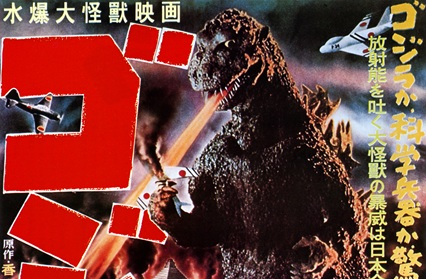
Godzilla (1954) is arguably the most distinct entry in the series. Here on my second rewatch, I would even go as far to say that it is hardly a Godzilla movie at all. In every entry except this one, Godzilla is treated with a reverence and mythologizing that is completely absent from this incarnation. The titular monster is hardly the focus plot. There is nothing inherently special about Godzilla in this movie. It is for all intents and purposes just a monster — a product of the hubris of man.
What caught my attention on this rewatch was how much time the movie spends on completely regular people. When I try to recall the plot of this movie, my mind immediately goes to the two scientists, the young and tortured Dr. Serizawa and the melancholic paleontologist, Professor Yamane. Together with Yamane’s daughter and assistant, I had thought of those four as the core cast of protagonists, but that is hardly the case. Sure, they take up the primary screen time in the back half, but they are mostly absent for most of the runtime.
The opening of the movie depicts a mass of relatives to missing fishermen — demanding the authorities to do more to find the cause of the disappearances. And when Godzilla rampages through local islands to metropolitan Tokyo, we are not seeing it through the viewpoint of plucky protagonists, but completely regular citizens. The parts of this movie that really strikes a chord are these snapshots of mundane people with no attachment to the larger plot. A particular memorable scene is a small moment where a mother is holding her children. As Godzilla destroys Tokyo she tries to to calm them down. In their final moments, the mother tells the children that soon they will be reunited with their father.

This is not a random remark to pull at your heartstring in a tense moment. A lot of attention is put on the people left behind. As said, the initial horror of Godzilla’s awakening did not come from the people on the attacked boats, but from their families on shore, desperate to find out what happened to them. On the small island where Godzilla is finally tracked down, a emphasis is put on a boy who loses his home and family due to Godzilla. The boy is then used as a witness to the government on the existence of Godzilla. And in another movie, that would be his sole function in the plot — exorcized from the script thereafter to tighten the viewers attention on the immediate plot.
But in this movie, the boy gets adopted by the Yamane household and sticks around — seemingly for no real purpose. When I first watched this movie, I found this hilarious. It seemed like such an odd detail to keep having him there in the background in pivotal scenes, but with no lines or real role to inhabit. But that is — of course — entirely the point. The destruction of Godzilla is only made significant because of those left behind to live with the aftermath. If everyone was killed — if there truly was nothing left — then it would not be scary at all. There would only be nihilistic emptiness.
Part of the reason why the depictions of survivors hit so hard is the knowledge that while Godzilla is fictitious, the people on screen are not. It is hard to ignore that this movie was made hardly a decade after the Pacific War ended — an event that would have felt apocalyptic to many Japanese citizens. There is melancholia that emanates from Godzilla (1954). It does not wallow in the horrors of destruction, but instead there is this ever-present sense of sadness and loss. Part of the tragedy of the movie is the need to kill Godzilla. Kill a wonder of the ancient world, the last survivor of a lost age.
A turning point in the movie is Professor Yamane falling into a stupor caused by his objections to killing Godzilla. He argues in favour of studying the beast, to turn Godzilla from a disaster to an opportunity to further the knowledge of mankind. But with the mounting casualties he is shot down. People are dying and you want to turn it into a research project? Yamane does not even have a real counterpoint. What inherent value that could be found from keeping Godzilla alive crumbles in face of the abject loss of human life. So he withdraws to his room, wallowing in self-pity for not being able to stand up to his ideals, lashing out against the people around him.

It is a haunting portrayal of the hollowing that war brings. The true casualty is not lives lost or material damages, but the loss of our capacity to work for beauty and good. What does abstract ideals matter with survival on the line? And so, the final dilemma of the movie is presented through Dr. Serizawa. The haunted scientist has invented a tool with the capacity to kill Godzilla, but at what cost? Godzilla itself is the product of technology that was similarly used to solve a do-or-die situation. Out of the atomic bombings a literal monster was born. Will the solution be another figurative bomb? Will we have to keep inventing bigger bombs to solve the troubles they birth? The reflection of this tragic cycle is part of the deep melancholia of Godzilla and what elevates it from a comparatively simple monster movie.
In the end, what motivates Dr. Serizawa to use his invention is not the rational arguments of his peers. My friend noted, that what actually convinces him is not the principal characters, but the unknown masses. At the pivotal moment of the climax, a broadcast is made of a school assembly, singing a song of peace. While adults are wrapped up in all this bullshit, the children are not. Godzilla was not just born out of the atomic bombings. What caused the monster to rise, was the continued test bombings that disturbed its natural habitat. The Japanese government itself inadvertently ends up attracting Godzilla to its shores by provoking it. Might the tragedy have been avoided if the authorities had been less hellbent on seeing Godzilla as an obstacle to be removed? Serizawa’s rejection of the cycle comes at an ultimate cost. When the invention is deployed against Godzilla, he sacrifices himself in the process. With his research notes gone, so is the possibility of recreating the technology — along with any good it might have been able to herald in a better future.

Godzilla as allegory for the atomic bombings is common knowledge. But as any good thematic motif, it is not as simple as thing=bad. Godzilla is a cautionary tale — not just of the horrors of war — but of seeing the world as a series of nails that needs to get hammered down. As a collection of problems that can be solved by dropping bombs on them. Even if it is foolhardy, moronic and out of touch with reality, insisting on what is good and beautiful is the only thing that will truly save us.
And what touches me watching Godzilla (1954) is precisely the sad realization that we are still trapped in that cycle — that we are still led by people seeing the world as problems to be hammered down. That bombs are still the ultimate solution when all else fails.
But this movie was made — grand and beautiful as it is — by people who lived through the bombs. And if they could keep hope for a better tomorrow, then so can I.
Leave a Reply