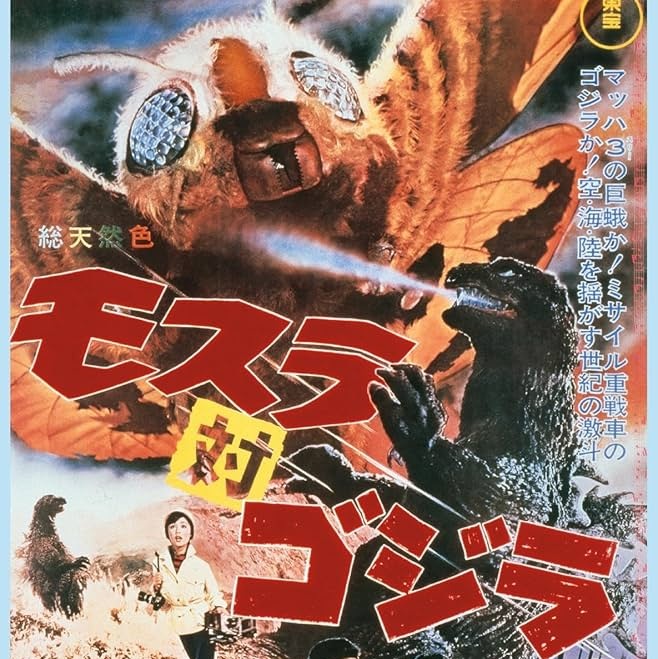
Review: Mothra vs. Godzilla (1964)
After King Kong vs. Godzilla (1962) showed the applicability of Godzilla as a frame for monster mash-ups, there really was no turning back. The Showa era would see Godzilla turn from tragic symbol, to stock element a producer could throw into a production to increase viewership.
These early Godzilla flicks are concurrent with some of Akira Kurosawa’s greatest works. Titles like Ikiru, Seven Samurai, I Live in Fear, Yojimbo, High and Low all released alongside Godzilla’s increasingly silly adventures. If your only exposure to Godzilla are the stories about its origin as a nuclear metaphor, you might expect the movies to be rather cerebral affairs. But reality is that most Godzilla films are incredibly schlocky experiences that are exactly as intellectual as you would expect from stories about giant monsters duking it out. I resist the impulse to broadly label these movies as »bad« even if they have that unmistaken B-movie vibe. While there are a good handful of Godzilla titles that provide food for thought, most of them are unmistakable cheap thrills.


Movie culture today is simultaneously inconsequential as a common cultural frame, yet still built upon massive expectation. Even movies that are arguably primarily about low-brow entertainment need to be these massive cultural events. For a good while I saw news reporting on the casting choices in Marvel movies like it was national leaders getting elected. The unsettling trick of those movies was that you did not just watch a movie — you entered a cinematic universe. You were invited into caring about the corporate planning of a media giant and view storytelling as a means toward this nefarious, big thing. It was a wave that continuously crashed over you till it had chiseled you down to a smooth surface. No one made Ant-Man and the Wasp: Quantumania because they had anything to say. The studio needed 124 minutes to open Phase 5. The significance of phases is something I was implicitly expected to understand.
Movies in the 60s were probably not hyped to be the seismic cultural events that a major movie release is today. But, digging into the making of these Showa-era Godzilla movies, there are some remarkable similarities. Seemingly, the studio would look at their production schedule and see a slot that could be filled with a Godzilla feature. They would collect story pitches from their workers and freelancers, pick the most interesting and task one of their staffed writers to turn it into a script. The movie would then be assigned a main director and — for effects-heavy movies like these — a separate director for the VFX-sections.
While these early entries in the series were primarily helmed by Ishirō Honda and VFX director Eiji Tsuburaya, that does not mean that they are auteur movies. While Honda definitely had a strong influence, my impression is not that he had the same level of artistic input as a director like Kurosawa. While Godzilla is inarguably his claim to fame, Honda has a distinct workman-like attitude toward the movies. The movies were largely assignments and it seems like he treated them as such.
This is a long, roundabout way of saying that Mothra vs. Godzilla is the first Godzilla movie that really feels painted by number. It will not be the last either, but it is apparent that the studio had the Godzilla and Mothra suit lying around, with an open production slot to fill. That is the bottom line really. It is a crossover movie between Mothra and Godzilla — exactly as advertised.


The divine giant moth will become a main player in the series going forward. And I remember being excited about the movie my first time around. Because, this was the genesis of an iconic foil to the atomic lizard. But today I am left with a single thought.
Mothra kinda sucks.
Sorry to the Mothra lovers out there, but it is simply neither a cool looking monster nor interesting conceptually. The problem with the match-up is intuitively apparent. How the hell does a moth fight a dinosaur? And the answer is: in a contrived and dumb way.
There is also a less obvious issue with the crossover. The themes of Godzilla and Mothra — while seemingly congruent — becomes a mangled amalgamation that works against the movie. What I enjoyed most in this movie was the initial plotline. Mothra’s egg washes up on shore and greedy moneymen immediately seizes the opportunity to exploit the situation. There is a strong core cast, with a trio of main characters: a hardworking journalist, his plucky female photographer and an aloof researcher. Their attempt at preventing exploitation — and later beseeching Mothra’s aid against Godzilla — is compelling. They are the strongest protagonists in the Godzilla movies so far.
In a funny way, the villains’ treatment of the egg forms a clear parallel to Mothra and Godzilla as pieces of fiction. They too have been reduced to property that needs to turn a profit.


Where the wheels come off for me, is when the trio travels to Mothra’s home — Infant Island. The place is inhabited by a tribal community that worships Mothra as their protector. The surrounding environment was desolated by nuclear testing and now the only greenery left on the island is Mothra’s sanctuary. This is a clear parallel to Godzilla’s own origin. My memory of Mothra (1961) is hazy at best, but in that movie the oversized moth raged because its twin, psychic fairies were abducted and forced to become media celebrities. That movie was a warning against the commercialization of the unspoiled. The fairies are both infantile and foreign to industrialized society. They work as stand-ins — both for children and indigenous people. They are disempowered and ripe for exploitation, which in turn leads to divine retribution in the guise of Mothra.
But in Mothra vs. Godzilla the divine moth is a force for good. Despite the greedy capitalists attempts at exploiting it, the protagonists beg Mothra to save Japan from Godzilla. The islanders angrily refuse. Even the benevolent fairies agree that the outsiders brought the destruction on themselves. And here the themes come apart for me. The tribal society solely wants to protect the last speck of unspoiled nature, and if it was not for the unexpected grace of Mothra, that would be the end of it. The conflict has no resolution. The greedy capitalists do themselves in. The heroic trio does not have to make tough decisions or come to term with anything on their end. The islanders are being made to be correct about their hostile isolationism. At this point the plot simply breaks apart and only picks up because the giant insect decides that gosh darn Godzilla needs a good walloping.


Despite my gripes with the narrative, I will say that the pacing is unusually good for one of these movies. There is a clear three act structure, with a dramatic initial showdown between the two titular monsters. Mothra is defeated, only for its larvae to emerge from the egg in time for a rematch at the climax of the third act. This movie also settles into unsatisfying trend. As part of the serialization of Godzilla as a franchise, the big lad can never be killed off for real. Godzilla always needs to be ready for the next movie, but it has firmly been established that it is nearly indestructible. So how do you deal with it as a narrative threat? Well, after getting silked up by Mothra’s offspring — Godzilla falls off a cliff and the movie ends. Calling it unsatisfying would be an understatement.
I have warmed up to King Kong vs. Godzilla over the years. This is despite the fact that a lot of similar critique could probably be lobbed its way. But the key difference to me is that while King Kong vs. Godzilla feels infused with a reverence to the idea of the match-up — Mothra vs. Godzilla comes off as decidedly manufactured and sterile.
Leave a Reply